Last weekend, I had a birthday. I turned fif–. Excuse me. I turned fift-.
Still working on that. Suffice it to say, it was a big one.
When I started this blog, I was just a tender, nubile lass of 48. My goals — apart from the bathtub full of money — were to motivate myself to keep up with an art and writing practice, and to have a record of my progress. I’d imagined I could be a resource for people wanting to learn to paint: I could pass on what I learned in my studies, and any readers I had could learn side-by-side with me.
I’ve since learned that people prefer to learn from folks who know what they’re doing. Go figure.
So in this (two-part) post, I’m going to turn it over to the experts. All of the resources that have brought me “aha” moments. But first, a bit of history.
I was not a kid who drew. That was Richie Lamb (SO cute). I was the kid who loved to read, and who wrote short stories, and who wanted to be a veterinarian. In college, I was an art history major, but only because I liked pretty things and had no idea what I wanted to do with my life (I’d discovered that being a vet was the world’s saddest job). I took a drawing class there, as well as a few other drawing and painting classes throughout my adulthood, and then started weekly painting classes at The Art Academy at the culmination of this blog.
You’ve probably taken similar drawing classes. The teacher puts apples on the tables, and everyone does their best to make their apple look better than the person’s sitting next to them. Every few moments someone sticks their pencil out in front of them to measure the exact angle of their stem. The next week it’s bottles. Bottles are harder, and people studiously try to capture the itty bitty reflections and the lettering on the label. You think yours looks pretty good, compared to the person sitting next to you.
At The Art Academy, it was the same. “There’s no reason to know how to draw in order to paint,” our teacher would say. “Just use your brush as an angle machine.” And so we drew with grids, breaking our canvas into squares and measuring every angle with our brush handles until it was a decent — if robotic — outline of the picture propped up next to us.
Doing this weekly, I got better at it. I no longer relied on my “angle machine” for every line — I could judge the direction and steepness of most of them closely enough. If someone had asked me at that point if I could draw, I would’ve said “Sure, if I’m looking at something.”
But if I tried to draw WITHOUT looking at something, it would look like this:
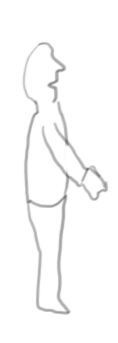
(That’s a person, by the way.)
WTF? What was I missing? How were some people able to create entire scenes of things that never happened? As much as my teachers tried to convince me that “anyone can learn to draw,” I really believed that only the Richie Lambs of the world (sigh!) would ever do it well. There was something I simply wasn’t born with.
When people who can “see” as an artist try to teach someone who can’t, it either comes off as overly tangible (a cat is simply two circles with five rectangles sticking out of them) or as so much mumbo jumbo (drawing is “seeing,” “believing,” “a lie”). And while I now know that much of that mumbo jumbo is actually true, it does little to help people understand what missing ingredient separates those who can from those who can’t.
I want to back up for a second, because I don’t want to come off as pretending to be some great artist. Clearly I am NOT. But the difference between where I started at 48:
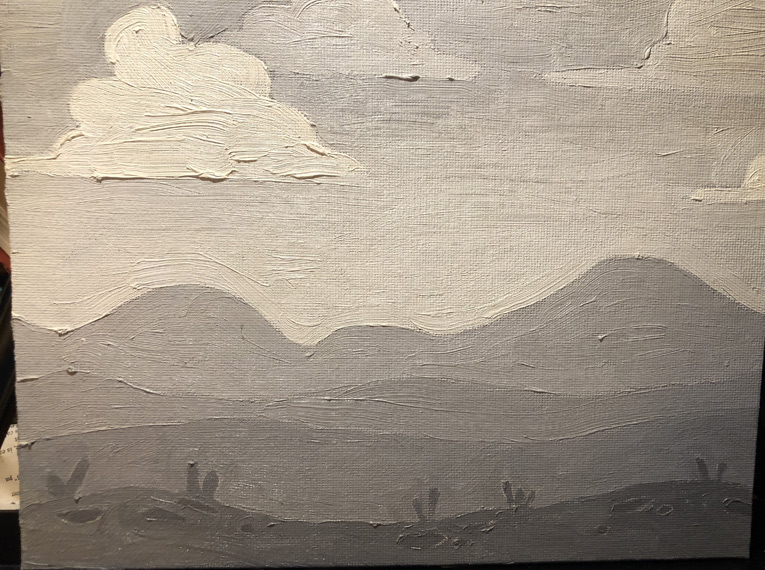
… and where I am at fif– ahem — where I am now:
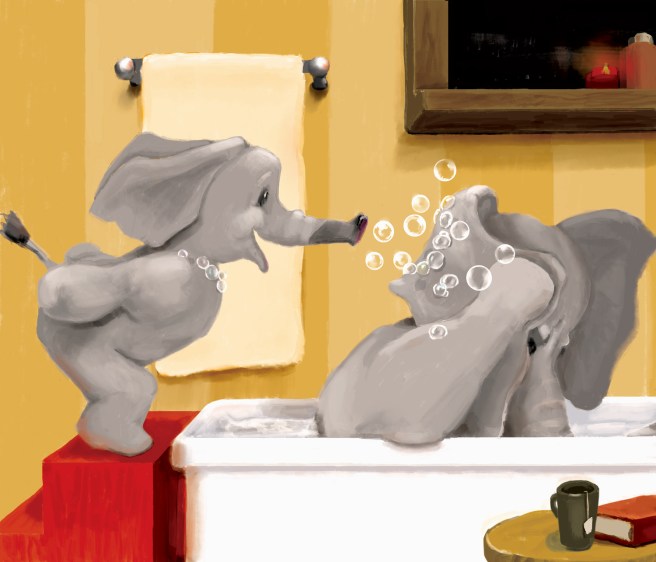
…is the difference of starting to SEE — of being able to put lines on paper and feel my way around a shape in 3d space, knowing as I do so which way I need to move, and more accurately discerning when I’ve judged incorrectly.
Clearly I’ve become fluent in mumbo-jumbo-ese. So I’ll just give you the regimen (part one).
Drawabox.com. To use a cliche, this is the equivalent of playing scales. It’s the most basic of basics — retraining your muscle memory to draw with your arm rather than your wrist, creating hundreds of boxes and checking how close you got to meeting at their vanishing points. Then cylinders. Then, if you want to go further, organic shapes like leaves. For some people, this would be unimaginable drudgery, but I’ve always thrived on this sort of busywork, especially when I feel like I’m laying a foundation. Every time I needed a break from work, or I was bored and waiting for something, out came the sketchbook. It took a couple of months of drawing boxes, but I was eventually able to visualize them in different positions, and fairly accurately draw them to their vanishing points. (I wasn’t quite sure yet WHY this was helpful, but I went with it.) And it became second nature to use my arm rather than my wrist for longer strokes, making my line quality much more confident and sure. (Bonus: Their content is FREE!)
Proko.com. After I’d gone as far as I wanted with Drawabox, I needed a new daily regimen. A friend of mine suggested Proko for figure drawing, and I jumped right in with the paid version (they have loads of free stuff as well; I can’t vouch for that). After months of drawing nothing but boxes and cylinders, it was a relief to draw humans, but… I’ll be honest: I sucked. I’d hoped to be further after my months of drudgery. It was true — definitely, unquestionably true — that my line quality was better. But comparing my ability to capture gesture from the model poses with that of the uber-talented instructor was humbling and disheartening. Much of the time, my “bean” (a form made from two oblongs that we used to synthesize the shape of a pose) was facing the wrong direction; on no occasion was I within the realm of accurate. Had I learned nothing? Furthermore, in his video critiques, the instructor kept criticizing students for “drawing the contours,” which seemed to me the art-equivalent of the thoroughly unhelpful “don’t be afraid of the ball.” If not the contours, what was I supposed to be drawing?
One of the issues I was finding was that Proko models are bumpy. Covering their arms, legs, and torsos were muscles I didn’t know existed (sorry, dear husband!) and that seemed to be in different places in every pose. While we could ignore these while drawing “the bean,” eventually the instructor was adding many of them to his drawing as “landmarks.” I couldn’t understand this. The church on the corner is a landmark, because it’s ALWAYS ON THE CORNER. It doesn’t sometimes appear two blocks up and shaped like a bank.
I realized that I didn’t know enough about the human body to be able to draw it intuitively. I was drawing the bumps, but I didn’t know what the bumps were, so I was once again simply relying on my “angle machine.” I’d always heard that you shouldn’t study anatomy until you’re comfortable with gesture, or your figures will be stiff, and that might be good advice. But I didn’t think I’d be capable of drawing gesture without better understanding anatomy. So I doubled down and invested in the 3-part Proko anatomy class. (Full disclosure: I attempted to memorize the dictionary in high school because I thought it would help me with my SATs. That’s just how I roll. This process may be more than many people need.)
This is where I started to understand what I’d gained by starting with Drawabox. When faced with an entire, contorted, bumpy body, I’d been overwhelmed and stymied. But when faced with drawing, say, the form of a ribcage, and then eventually visualizing where that ribcage would be placed, and how it would be rotated in certain poses, it was much more manageable to understand how it lived in 3-d space. My drawings — compared with the instructor’s drawing of the same — began to be more accurate. What’s more, I learned and began to understand the bones and muscles, so I was able to see the “landmarks” — tiny depressions or curves that were sometimes mere shadows on the surface but that helped to define form and proportion, and place other features.
Have you ever read Roald Dahl’s “The Wonderful Story of Henry Sugar”? (You MUST!) In this book within a book, Henry Sugar has just read the account of a man who can see without his eyes, Imhrat Kahn. Figuring he could use this skill to cheat at gambling, Henry undertakes a years-long meditation practice to attempt to harness the ability. Finally:
Sometime within the tenth month, Henry became aware, just as Imhrat Kahn had done before him, of a slight ability to see an object with his eyes closed. When he closed his eyes and stared at something hard, with fierce concentration, he could actually see the object he was looking at.
“It’s coming to me!” he cried. “I’m doing it! It’s fantastic!”
I had my Henry Sugar moment several months into my drawing regime. Until that moment, I’d only drawn what my regimen had told me to draw: boxes or cylinders, ribcages or pelvises, or –badly — the swoop of the human form. I’d never attempted to draw something from imagination, because, well, that just wasn’t something I did. But now I attempted it. I drew a giraffe.
I’m not going to claim it was a great giraffe — I’m not familiar enough with a giraffe’s body to visualize it well enough for accuracy. But as I moved my pencil on the page, I wasn’t just drawing the outline of a giraffe. My pencil was understanding how the giraffe’s body lived in 3-d space, with foreshortening and form. I suddenly understood what had been meant all along by “don’t draw the contours,” and “drawing is seeing.” I was starting to see. And it was fantastic!
Obviously, there’s more to drawing (and digital painting, which I like, and do) than this, and in part two of this post I’ll explore some of the other resources that I’ve found invaluable while learning about light, color, composition, facial expression, and digital painting.
Stay tuned!

 From Mess to Master(y)
I loved this soo much thank you for writing this!
LikeLike
Oh, thank you so much! I’m glad you liked it. Thanks for reading (and commenting)!
LikeLike
Thank you for sharing this! I feel like I’m in a similar boat learning anatomy, perspective, values, etc. and not too many people document the mindset of a beginner artist and I feel like that’s often overlooked by pros or teachers. The result being more confusion after a lesson and your remark about the “overly tangible” and “mumbo jumbo” is too true lol.
I highly recommend Proko’s and Marshall’s art podcast Draftsmen for a lot of great advice geared toward beginner artists and artists looking to find some way to improve their skills. They cover a wide range of topics and Marshall is a treasure trove of wisdom with a great voice to boot.
Looking forward to more!
LikeLike
Yes, I agree — I like that podcast as well! (And if you haven’t checked out Marshall’s ancient class on perspective, it’s worth a watch. He explains things really clearly — though tough to refer back to in that format. ) I think so many people learn to draw as kids, they don’t realize how difficult it is to come to it later, so always good to compare resources. Thanks much for the words of support, and good luck!
LikeLike
Hi Jennifer! I discovered this post on the /artfundamentals subreddit. I’m fifty four (that rolls off the tongue after enough practice) and am about 1/4 of the way through the 250 box challenge. We seem to be cut from the same cloth as I too puzzle at how people can draw from their imagination. And memorizing the dictionary is something I once attempted. 🙂
Looking forward to part 2!
Thanks again!
LikeLike
Too funny! Glad to hear it gets easier! Good luck wading through your boxes…and cylinders…and banana-kiwis…
LikeLike
I’m at the point where you were with the proko gesture class. My gesture drawings are so bad, watching the crit videos of them criticizing gesture drawings which are way better than mine has put me off a little. You said you signed up for the figure drawing course – was that the missing part? I’ve signed up for so many courses and scared this will be another that is too advanced for me.
Do I keep pushing ahead trying to understand the bean and robobean, or should I learn figure drawing first.
Thanks, sorry this is super months after you wrote this, but only found it today
LikeLike
Hey! I certainly understand the frustration. I did do the figure drawing class first, but I didn’t make it all through. I was completely baffled by the bean and the robobean — I was never able to get the twist going in the right direction, and just felt like I wasn’t really getting it. And then when it moved to doing entire bodies I just felt like I was trying to trace the outlines — measuring every angle — because I didn’t have enough knowledge of anatomy to really know what I was looking at, and my brain hadn’t made the leap to thinking in terms of volume. I skipped to the anatomy course because I thought it would be easier to learn the body piece by piece, and in some ways I think it was, because there’s simply less information to take in at one time. But that’s not necessarily the best course of study for everyone — I think for me it was helpful less in terms of anatomy, and more because I was having to look at a structure — say, a ribcage — and try to draw it from all sorts of different angles. I was always wrong — sometimes not even close — but I’d watch him demonstrate and then try it again and again until I got closer. Sometime in those months of doing that kind of thing, my brain made some kind of leap where I was able to think in volume rather than outline. But I didn’t even realize it until I tried to draw from imagination, and even now, if I’m drawing something from a reference, I can’t continually look at the reference or my brain goes back to looking at outlines. I have to study the reference and then put it away in order to actually draw it correctly in 3-d space — it’s kind of like a switch in my brain.
But I can’t say that my drawings ever looked as good as the ones that he critiques — some of those people are just really, really good. In fact, I just went back a few weeks ago and started taking the anatomy class again, thinking I could use a refresher on some parts of the body — and I’m certainly much better at getting the structures positioned correctly on my first attempt. But the ones he critiques are still much better than mine; I just don’t have great line quality.
I would say that the bean and robobean are helpful in making that leap — anything where you’re taking increasingly more complex structures and trying to visualize how they’d look from many angles. And just trying again and again to see if you can get closer. As far as the rest of that class, I didn’t find it that helpful because I wasn’t ready for it. At that point it would’ve probably have been better for me to just concentrate on drawing a couch, or a lamp — anything more simple than an entire body.
Good luck! It does take a ton of work — I’ll definitely be learning my whole life. But it does come.
LikeLike