My very first painting. Don’t blame the school!

Most of the biggest fights I’ve ever had with my husband came down to the fact that I’m a take-charge, active person, and he’s a passive cow. (He might’ve framed these fights differently. It’s MY blog.) So after so sensitively drawing Dopey and the Oven Mitt, I was anxious to lay in some paint. I had a space above the fireplace ready for it, and I don’t like to wait. (And that’s a GOOD thing.)

Alas, class wasn’t for another week, and my drawing was still locked up in The Art Academy’s thermohygrometer-monitored (I assume) vaults. But now that I had da skillz, I could start over — I could keep moving ahead!

Unfortunately, I wasn’t able to find this particular work in any of my old art history books. Instead, I searched online for something with the same clean lines, and found this:

istock

I knew I might have trouble with the little “iStock by Getty Images,” but the rest looked pretty easy. After all, I already knew how to tone my canvas, hold my paintbrushprepare my palette, and draw with a grid. Also, I had been through childhood. I figured I got this.

So after preparing my palette and grid and drawing my lines (and holding my paintbrush!), I picked out some greys to use. (I probably would’ve gone straight for color — I don’t like to wait — but we hadn’t bought any). And I painted.

Pretty good, right?
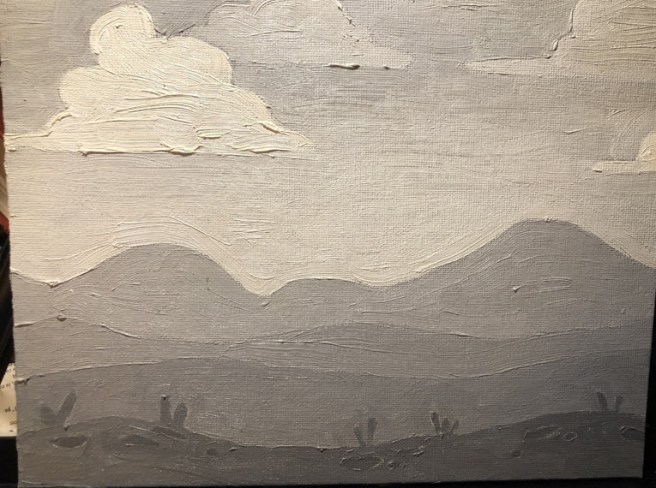
firstpic

I mean, I knew I had some trouble with the little protuberances at the bottom — that I can blame on a bad lighting situation — but my curves looked pretty good, and I even did that cool gradient thing in the sky. We hadn’t even been taught that — extra credit!!

Then I brought it to class to show Jim.

I didn’t want to be one of those little suck-ups who does extra homework and then shows it off to the teacher — I know everyone hates that kid (I was that kid). So I framed it in terms of a question I really did want to know: When would I add the protuberances? Would I actually draw in those little details, or lay them in over the top of the other paint? But really, I wanted him to praise my natural talent. (I’m still a little suck-up at heart.)

He didn’t.

Jim is a very positive person, and I could see on his face that he was struggling mightily to say something kind. “It’s really great that you’re so…enthusiastic,” he managed. “But we’ll be talking more about the right way to put down paint in tonight’s demo.” The right way. Ouch.

The fact that there was a right way, though — even for such a simple painting — was obviously news to me. In my next post, I’ll show you what it was.
Leonardo who?

art-academy-from-web
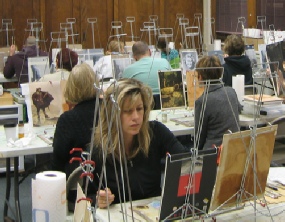
Student painters at The Art Academy (from their website)

The Art Academy is located in a dumpy little strip mall on Snelling next to a liquor store — hardly the location to foster rarified beauty. Inside and downstairs, where my class is being held, students sit grouped at big tables, and the deeper you go into the room, the brighter and shinier the supplies and clothes, the more nervous and excited the participants. My class was against the back wall — the kids’ table.

My new teacher, Jim, is the founder of The Art Academy. That first night, I wasn’t sure what to make of him: He has a very dry, bored way of speaking that reminds me of Ben Stein in Ferris Bueller, minus the “anyone? anyone?”‘s. He didn’t seem particularly anxious that night to learn our names, and told us almost immediately that he asks for quiet during class because his eyesight is quite poor and it requires intense concentration for him to critique our fine details. Clearly, we were not there to have fun.

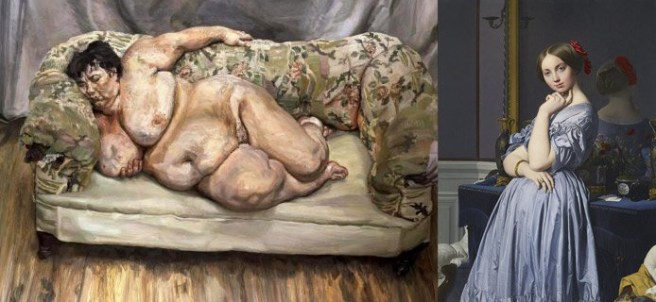
The first part of class was spent filling out a questionnaire meant to evaluate our background and interest in art, while Jim went to help the more advanced students. “I feel judged,” I said to the woman next to me after scanning a few of the questions. “Oh, have you gotten to the question about the last time you took an art class?,” she asked. I had not. I had gotten to the one about the last time I read an artist biography or art magazine; the last time I visited a gallery; the last time I had a conversation about art. Twenty-eight years; twenty-eight years; twenty-eight years. For the question about my three favorite artists, I racked my brain for some of the names I remembered from college. I knew I had done my senior thesis on an artist named Lucian Freud… or was it Lucius? Thirty years ago I think I had liked Ingres… was that someone?  I dimly remembered liking an artist that painted a lot of obese nudes — who was that? And then, for the last one… Leonardo da Vinci. A safe bet. I decided to make my writing very messy in that section.

freud-ingres
Paintings by Lucian Freud (left) and Jean-Auguste-Dominique Ingres. It was Freud!

Over the course of the evening, however, Jim — and the class itself — started to grow on me. First of all, he had a real reverence for DOING THINGS RIGHT — there was nothing half-assed about his instruction. It’s true that his speech about what materials to use to be sure our work would still be sound in 200 years drew some stifled giggles from those of us who couldn’t imagine our audience ever being wider than our own families, but when we’re starting from nothing, didn’t it make sense to start with the right habits, the right technique? And while he was quick to criticize most art professors and programs, he was incredibly positive with us, praising us for our “great questions,” and even our abilities to pat toner onto canvas. Lastly, he gave us this great piece of advice (paraphrased): “We all have busy lives. Some of you work full-time; some have kids. There’s always going to be something that makes you think you don’t have time to paint. That’s why it’s vitally important that you plan your painting time into your week. Can you get away for a couple of hours on a Monday afternoon? Can you wake up before anyone else on a Saturday? If you schedule your painting time in advance, and treat it like a job, a priority, you’re much more likely to stick to it. And the more hours you can practice, the more quickly you’ll advance.” Amen.

Perhaps most importantly though,  all the while he assured us that we will learn, that anyone can, and all the while we saw as seeming proof the beautiful work of the group at the very next table. I’m ready!

My new school!

With my much anticipated Aunt-money set to arrive any week, I set about looking for the proper painting class to take. I’m a big fan of Community Ed, and Saint Paul’s version has no end of inexpensive art classes, but Aunt-money meant I could go big. University of Minnesota? Maybe not that big. Articulture? Nothing offered for months. Instead, I chose The Art Academy on Snelling, because it was close and because it got good reviews on Yelp and Facebook. I liked the philosophy they espoused on their website:

At the Art Academy we always stress practice over talent. We believe that if students put forth their best efforts during each class their abilities will flourish – unlocking a level of artistic potential that goes well beyond their expectations.

exterior

Granted, that wasn’t a high bar — my expectations were pretty low. But the student work they showed on their website was genuinely impressive, and their student-to-teacher ratio impressively low.  Although there was a lot of cross-over between class descriptions, with no obviously suggested order, I decided on “The Oil Study,” because it spoke specifically about giving students the skills to start a painting, which made more sense than the other beginning oil painting class that talked about skills around finishing a painting. Oddly, though, while other class galleries showed student work in richly-colored palettes, Oil Study paintings were exclusively in shades of grey. Would I only be painting in black and white? What gives?

grey-paintings
Liven up, dudes!