Leonardo who?

art-academy-from-web
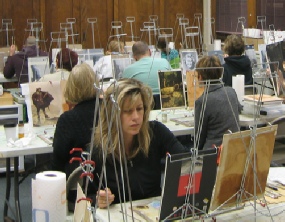
Student painters at The Art Academy (from their website)

The Art Academy is located in a dumpy little strip mall on Snelling next to a liquor store — hardly the location to foster rarified beauty. Inside and downstairs, where my class is being held, students sit grouped at big tables, and the deeper you go into the room, the brighter and shinier the supplies and clothes, the more nervous and excited the participants. My class was against the back wall — the kids’ table.

My new teacher, Jim, is the founder of The Art Academy. That first night, I wasn’t sure what to make of him: He has a very dry, bored way of speaking that reminds me of Ben Stein in Ferris Bueller, minus the “anyone? anyone?”‘s. He didn’t seem particularly anxious that night to learn our names, and told us almost immediately that he asks for quiet during class because his eyesight is quite poor and it requires intense concentration for him to critique our fine details. Clearly, we were not there to have fun.

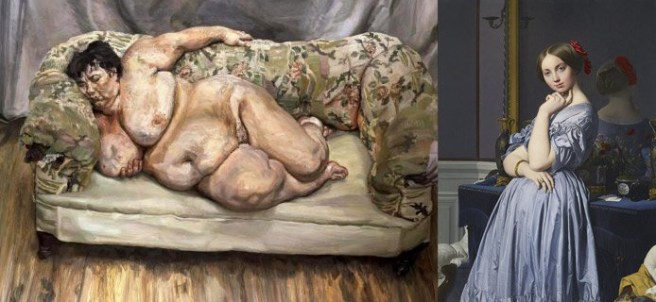
The first part of class was spent filling out a questionnaire meant to evaluate our background and interest in art, while Jim went to help the more advanced students. “I feel judged,” I said to the woman next to me after scanning a few of the questions. “Oh, have you gotten to the question about the last time you took an art class?,” she asked. I had not. I had gotten to the one about the last time I read an artist biography or art magazine; the last time I visited a gallery; the last time I had a conversation about art. Twenty-eight years; twenty-eight years; twenty-eight years. For the question about my three favorite artists, I racked my brain for some of the names I remembered from college. I knew I had done my senior thesis on an artist named Lucian Freud… or was it Lucius? Thirty years ago I think I had liked Ingres… was that someone?  I dimly remembered liking an artist that painted a lot of obese nudes — who was that? And then, for the last one… Leonardo da Vinci. A safe bet. I decided to make my writing very messy in that section.
freud-ingres
Paintings by Lucian Freud (left) and Jean-Auguste-Dominique Ingres. It was Freud!

Over the course of the evening, however, Jim — and the class itself — started to grow on me. First of all, he had a real reverence for DOING THINGS RIGHT — there was nothing half-assed about his instruction. It’s true that his speech about what materials to use to be sure our work would still be sound in 200 years drew some stifled giggles from those of us who couldn’t imagine our audience ever being wider than our own families, but when we’re starting from nothing, didn’t it make sense to start with the right habits, the right technique? And while he was quick to criticize most art professors and programs, he was incredibly positive with us, praising us for our “great questions,” and even our abilities to pat toner onto canvas. Lastly, he gave us this great piece of advice (paraphrased): “We all have busy lives. Some of you work full-time; some have kids. There’s always going to be something that makes you think you don’t have time to paint. That’s why it’s vitally important that you plan your painting time into your week. Can you get away for a couple of hours on a Monday afternoon? Can you wake up before anyone else on a Saturday? If you schedule your painting time in advance, and treat it like a job, a priority, you’re much more likely to stick to it. And the more hours you can practice, the more quickly you’ll advance.” Amen.

Perhaps most importantly though,  all the while he assured us that we will learn, that anyone can, and all the while we saw as seeming proof the beautiful work of the group at the very next table. I’m ready!

How much is that squirrel in the window?

After sending in the check for my class in late November, I didn’t hear anything back from the school until last month, a week before the class was set to begin. In a hand-written envelope, I received — absent of anything else — a materials list whose items were partially obscured by fading printer ink. My check had yet to be cashed.

 The Art Academy, Inc.

    Adult Oil Study Techniques Class
    Materials and Supply List

The art supplies listed below can be purchased as a kit at the art supply store Wet Paint, 1684 Grand Ave., St. Paul, at a discounted rate. Please purchase Gamblin oil paints.
Do not buy student grade paints.   This oil painting kit is an investment and will last for many years.

Required Paint

• Titanium White, 150 ml tube
• Portland Grey Light
• Portland Grey Medium
• Portland Grey Deep
• Ivory Black
• 3 Sets of 3 – 9”x12” canvas boards (for a total of 9 boards)
 
Brushes, Mediums, etc.
(If you have purchased oil painting supplies for our Traditional Drawing and Painting or Renaissance Drawing and Painting Techniques and Beyond classes you should already have these brushes and mediums)

• Silver Bristion round #0 (or equivalent)
• Signet round bristle brushes, #0, 2, 4, 6 (or equivalent)
• Signet filbert brushes, #1, 2, 4, 6 (or equivalent)
• Signet flat brushes, # 2, 4, 6 (or equivalent)
• Richeson watercolor brush, #1 (or equivalent)
• Richeson watercolor brush, #0 (or equivalent)
• M. Graham Walnut Alkyd Medium, 4 oz.
“The Masters” Brush Cleaner #101
• Richeson 36×36 cm brush mat or any other brush holder
• Richeson #894 palette knife
• 1 pint Gamsol
 
Household Items

• Shoebox or Tackle box to hold art supplies
• Roll of Paper Towels (to be left at classroom). Bring a new roll every session.
• 3 small jars with tight fitting lids

This seemed like a lot of materials to me, and I mentally calculated how much Aunt-money I’d have left once the school got around to cashing my check. I had no idea how much art supplies might cost, but I didn’t like the sound of “investment.” I did like the sound of “discounted rate” however, and Wet Paint is right down the street from me, so I decided to do the moral thing and purchase my new supplies locally rather than buying them online. Take that, Amazon!

wetpaint
Wet Paint, on Grand Ave., Saint Paul

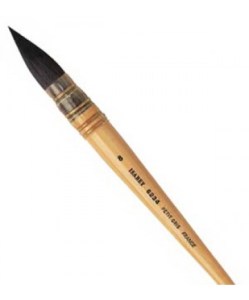
Art stores are exciting places, but at age 48 I still can’t help caring that I’m never going to look hip enough to seem like I belong in one. I took my 11-year-old daughter, Olive, with me for support, and we were approached almost immediately by a guy who very clearly did belong there, offering to gather up our inventory. This struck me as a good idea, because it would’ve taken hours for clueless us, and because it gave me the chance to look around at the sea of wonders I was anxious to dip my toes into. Glue made from rabbits! Four-hundred-dollar brushes made from sable! One-hundred-dollar brushes made from squirrels (Siberian blue ones at that)! I didn’t care to think of the adorable little mammals who sacrificed their outer coverings for the sake of someone’s ideal brushstroke, but there’s something very beautiful about the tradition that must be involved in creating something so unique and perfect, so opposite of mass-produced. I can imagine the fourth-generation artisan, um, gently shaving the squirrels to gather those fifty perfect hairs, which will then be used to create someone’s perfect painting, to be hung in someone’s perfect building. So much beauty.

squirrel-brush
A squirrel-hair brush from Wet Paint. So cute!!

My new brushes, however, were made of good old-fashioned synthetics, and wouldn’t be creating much beauty, at least for awhile. I met the Art Dude up at the counter, and realized quickly, as I watched the computer screen flashing its totals, that –for better or worse — the expediency with which this task was getting done came at the price of doing what I always do: picking out the cheapest option. Instead, my heart did a little flip-de-doo as he read me my total: two-hundred and sixteen dollars. Gulp.

It was only when I got home that I realized what my new kit didn’t contain: color. Apparently, painting like the old masters meant going back to the time when the world was still in black and white!

bw-renaissance
Back before God invented color

My new school!

With my much anticipated Aunt-money set to arrive any week, I set about looking for the proper painting class to take. I’m a big fan of Community Ed, and Saint Paul’s version has no end of inexpensive art classes, but Aunt-money meant I could go big. University of Minnesota? Maybe not that big. Articulture? Nothing offered for months. Instead, I chose The Art Academy on Snelling, because it was close and because it got good reviews on Yelp and Facebook. I liked the philosophy they espoused on their website:

At the Art Academy we always stress practice over talent. We believe that if students put forth their best efforts during each class their abilities will flourish – unlocking a level of artistic potential that goes well beyond their expectations.

exterior

Granted, that wasn’t a high bar — my expectations were pretty low. But the student work they showed on their website was genuinely impressive, and their student-to-teacher ratio impressively low.  Although there was a lot of cross-over between class descriptions, with no obviously suggested order, I decided on “The Oil Study,” because it spoke specifically about giving students the skills to start a painting, which made more sense than the other beginning oil painting class that talked about skills around finishing a painting. Oddly, though, while other class galleries showed student work in richly-colored palettes, Oil Study paintings were exclusively in shades of grey. Would I only be painting in black and white? What gives?

grey-paintings
Liven up, dudes!