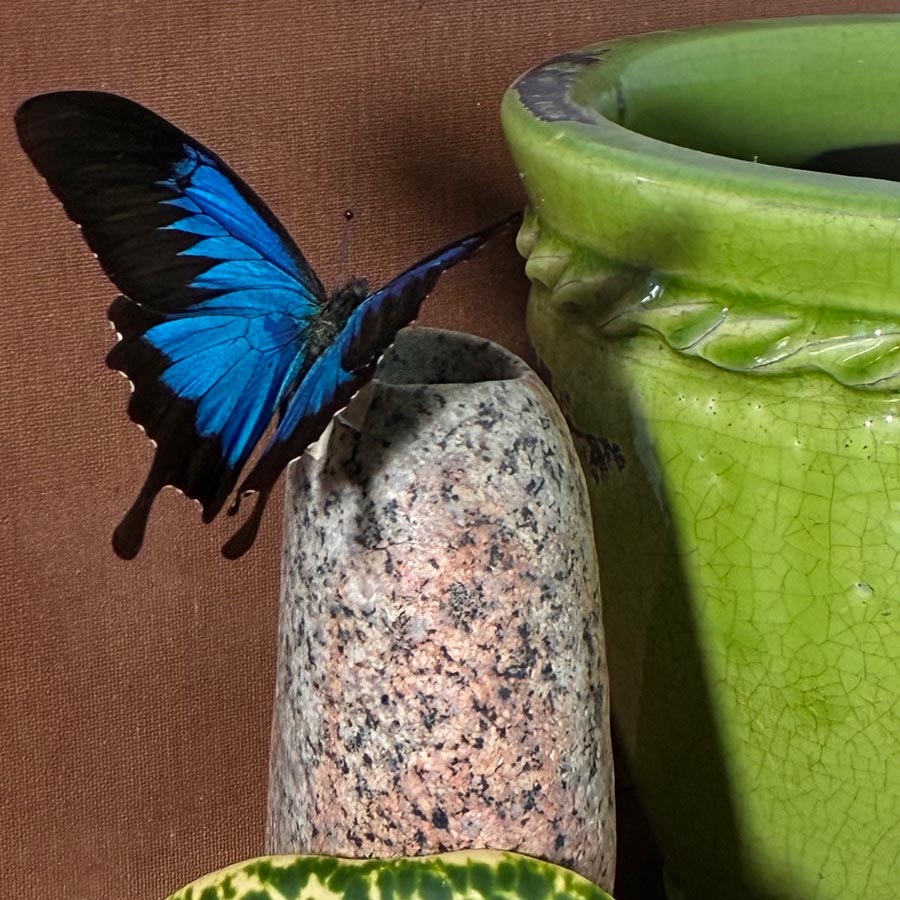
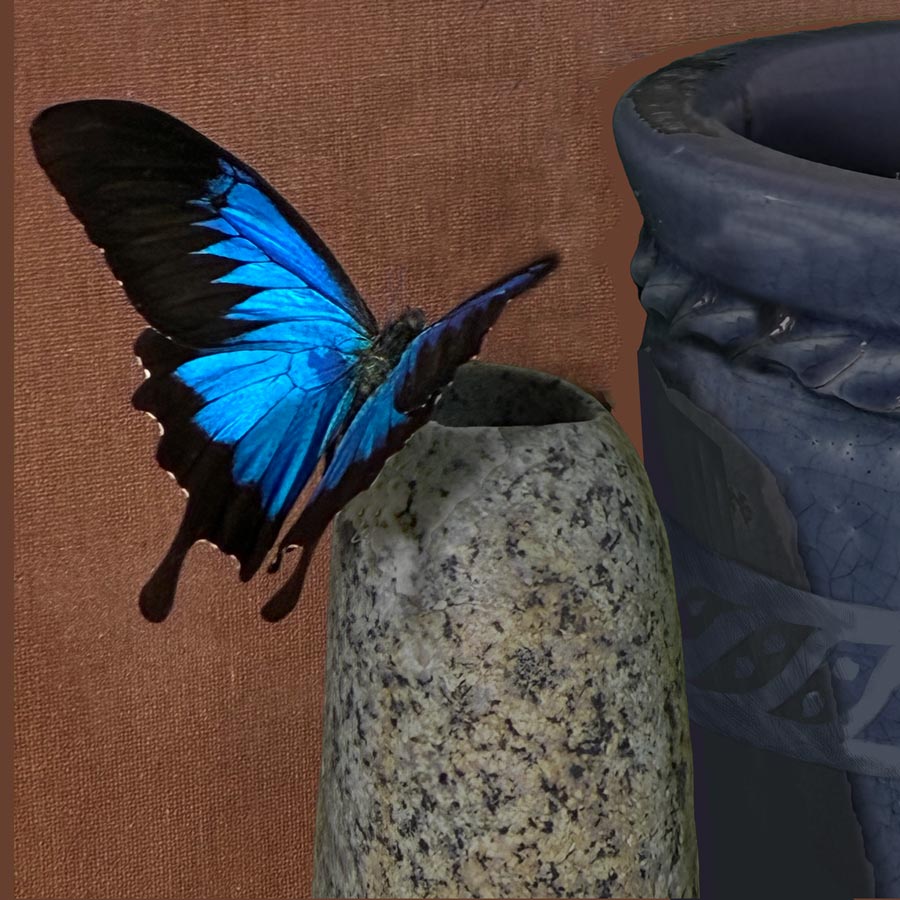
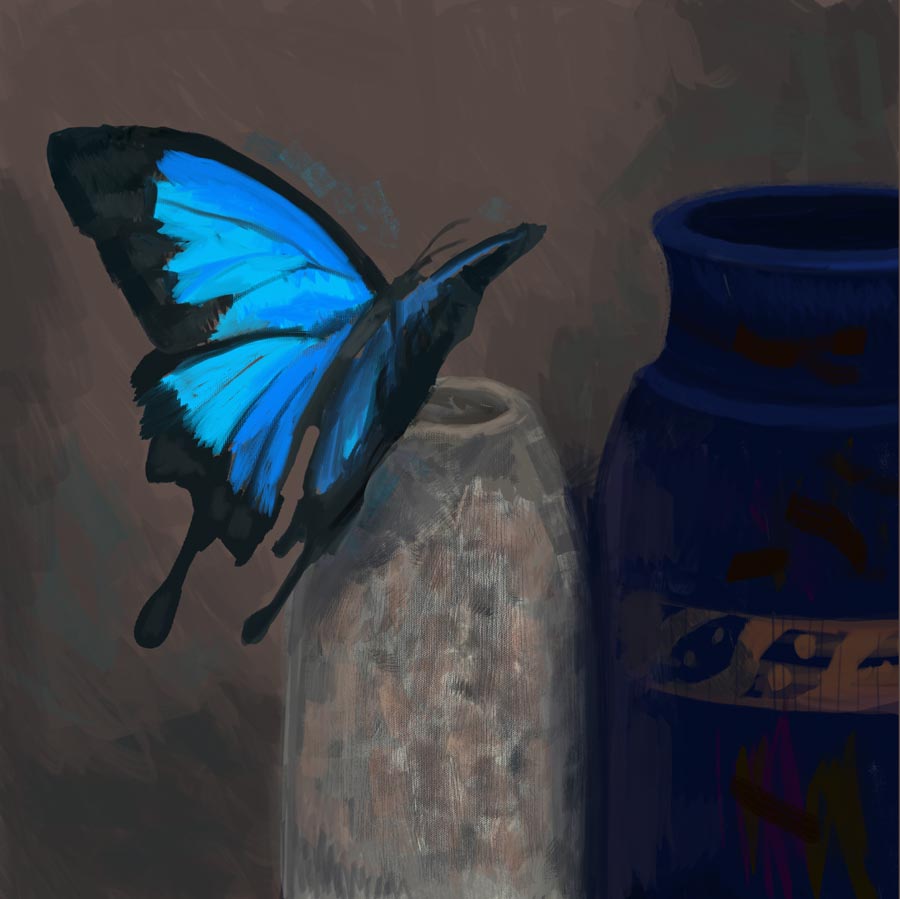
…And one step back.

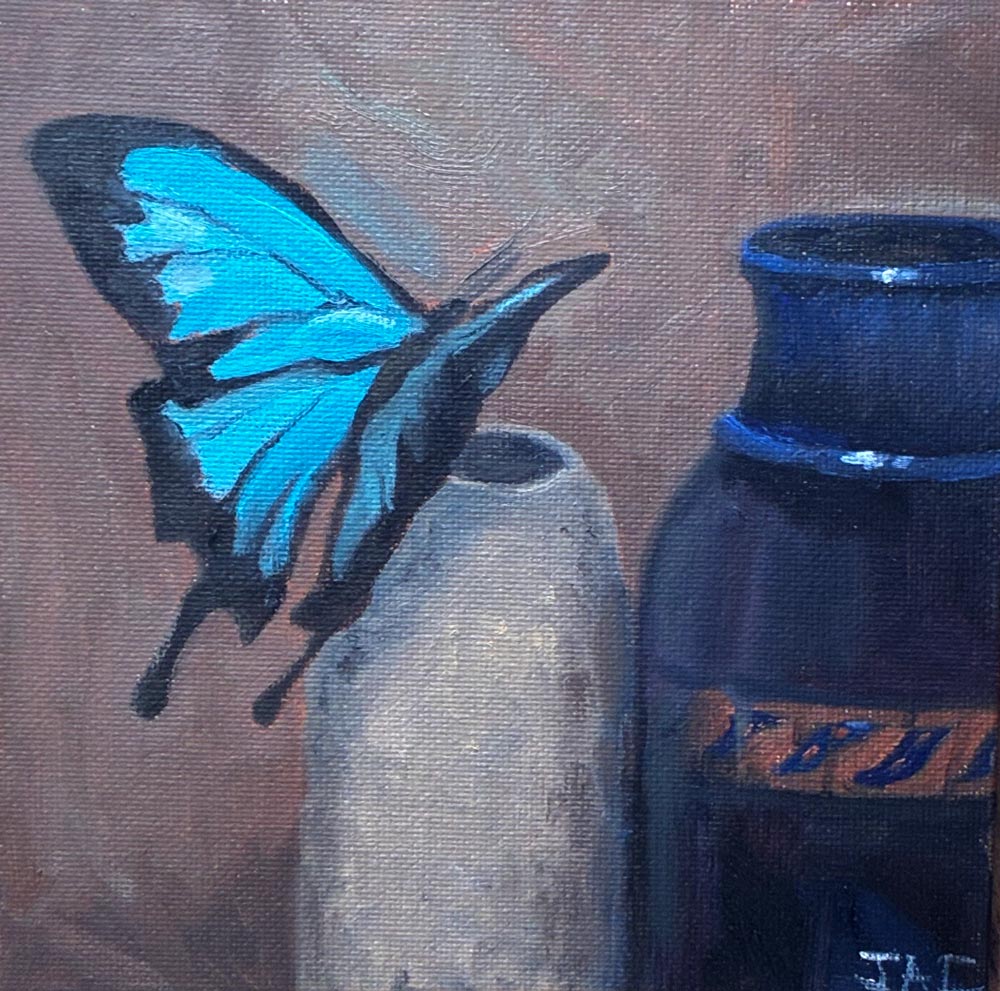
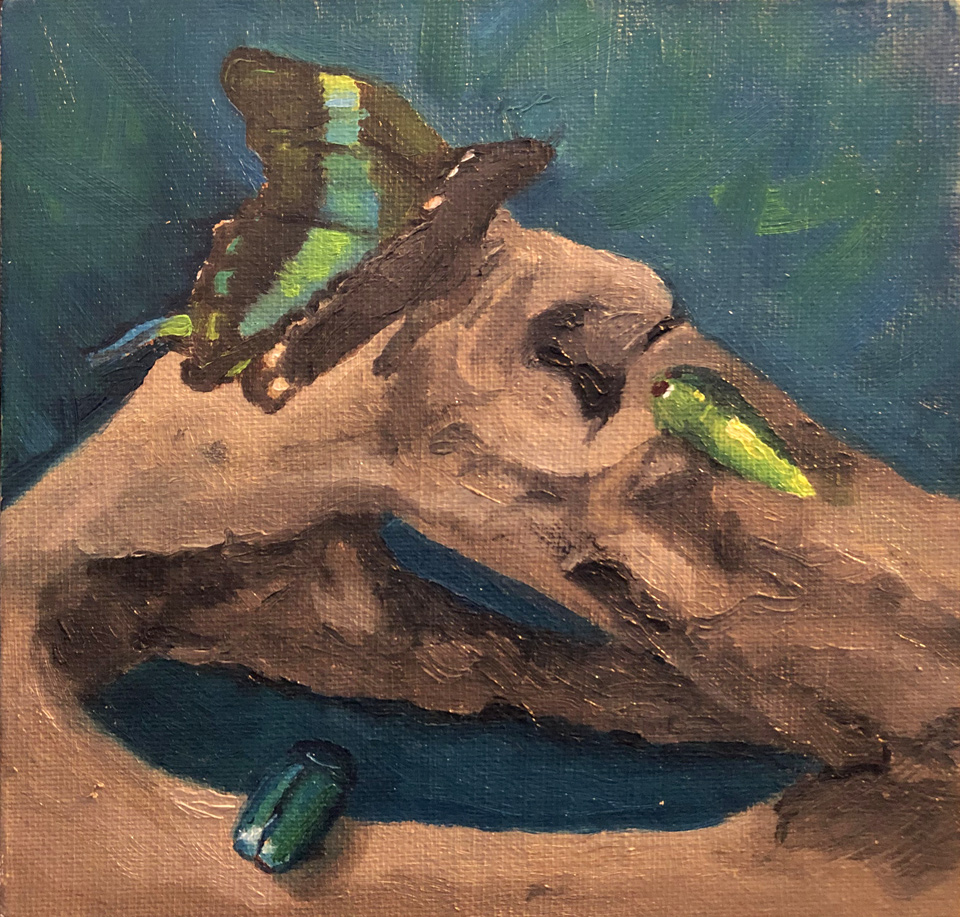
It’s funny how I can mention the same thing week after week — “I did a good job with my values,” “We’re waiting on color so we can work on our values,”– and still manage to miss the mark. I’d been admiring the work on Etsy of this amazing Ukrainian pet portrait artist, and wanted to see if I could create a background like his — loose, unstudied, the perfect complement to the (also perfect) subject. Turns out…I couldn’t.

My original thought was that the green bug would be the focal point and the butterfly and blue beetle would be a similar color to the background and therefore less prominent (I’d read that the area with the most contrast draws the eye the most and should therefore be your focal point). And it is true that parts of the butterfly and blue beetle are fairly subdued next to the dark background — their values are fairly similar. But instead of doing what I should’ve done — simplifying and darkening the background beneath the green beetle so that the contrast is greater, perhaps increasing its size — I plopped a very small beetle on top of a busy area of varying values. Perhaps, if you squint, you still notice it first because of the contrast between the bright yellow and the very dark green beside it, but it’s a close toss-up with the butterfly wing (which has the advantage, of course, of being much larger), and that, in my opinion, makes for a pretty unfocused painting.

While I’m glad that I don’t have even more detail in the background, I’m no Ukrainian Etsy artist. It would’ve been helpful to have a horizon, or some depth of field, and certainly the line of the driftwood should’ve been softened to integrate better with the background. As it is, it looks more like a collage than a painted-from-life still life.

In general, though, the entire thing is just way too complex for such a small (6×6) painting.

What?! Way too complex? Who are you, Jennifer Caritas!

(As an aside, if anyone’s curious about my subject matter, I used to make these fancy insect displays, and still have tons of insect inventory. Look for more bugs in future paintings!)

What I did well:
Individual elements are okay — I actually quite like the blue beetle.
I attempted some brushwork of varying directions and colors — a first for me. A for effort!

What I could’ve done better:
Too much going on!
Too much similarity in values — need a more obvious focal point
Better integration with background

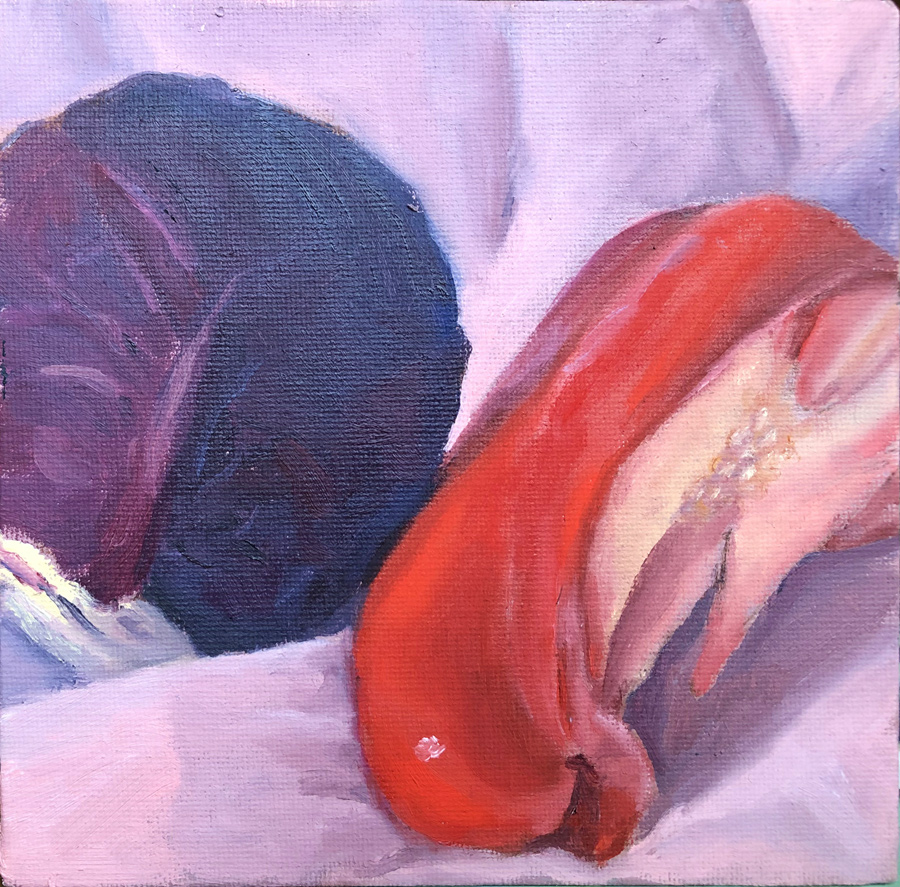
Still life with veggies: I’m a complicated gal!

One thing I always tend to do when taking up a new endeavor is to rush in and take on the most complicated challenge I think I might possibly be able to handle, skipping over those baby steps that really build a solid foundation. With painting, it’s not just the challenge though: I worry that if I were to, say, paint apples, my painting would be one of five billion other apple paintings with nothing to really separate it. Logically I know, of course, that focusing on more simple subject matter is a way to develop a style (as a hack — I mean, a novice — I haven’t yet found my style), and that I’ve seen apple paintings that have taken my breath away. This tussle between my logical self and my…self-self (for lack of a better word) is on display in my latest still life: Veggies.

My logical self led the way: I was going to skip the shells and driftwood this time and find something from my fridge to paint. But me being me, I once again got over-complicated (in my defense, though, I’d eaten the other half of my still life the night before).

My proportions seem pretty far off here — the purple cabbage looks more like a purple Brussels sprout (though would a Brussels sprout leave a big purple mark on my husband’s pink shirt?) — and both veggies look a bit cut-and-pasted. Part of that, I think, is because the cabbage is actually half-eaten as well (it’s missing its entire back half), so it’s not casting the shadows one would expect of a spherical object. The pepper, though, also has that effect and I have no excuse for that (I…suck?). I suppose I’m at the stage with this whole painting thing where I can see my flaws but can’t quite identify why they’re happening or how to put a stop to them. It’s a frustrating place to be, but I know, logically, that it’s one step further than not being able to see my flaws at all (I’ve evolved from the Trumpian stage, happily).

Things I did well:
Decent composition — objects aren’t simply plopped in the center any longer — and decent values/contrast
I like the brushwork on the top part of my cabbage — it says a lot with just a few brushstrokes

Things I could do better:
Proportions
Better integration into background

C-c-c-color!

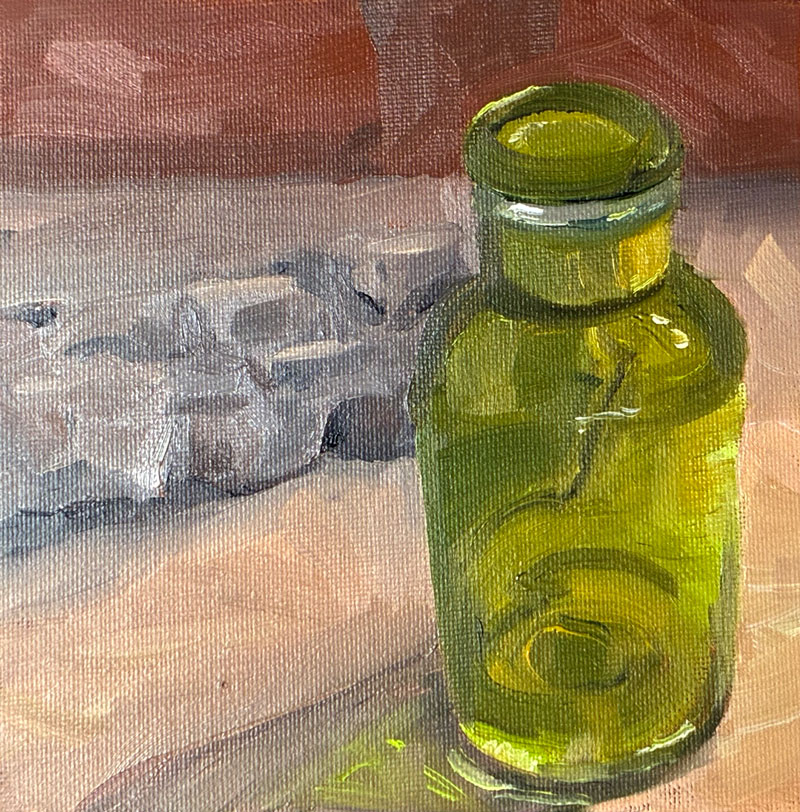
We’re still at the stage where all of our paintings for class have been in shades of grey: grey oven mitts, grey boxes, the beginning stages of grey horse heads (more on that to come). It makes sense — people perceive value before color, and mastering that in greyscale is much simpler and less distracting — but man, is it boring. Until now, I’ve been faithful to the method, figuring that painting one more grey oven mitt was just like Ralph Macchio waxing Mr. Miyagi’s car, but when I sat down to paint on Saturday and remembered I had run out of Portland Grey Medium, temptation got the better of me. I had recently been to a neighborhood estate sale, and had bought a big case of oils for $5 (to give you a better sense of the quality of these paints, they were mixed in with a bunch of Bob Ross acrylics), so figured what the hey, why not?

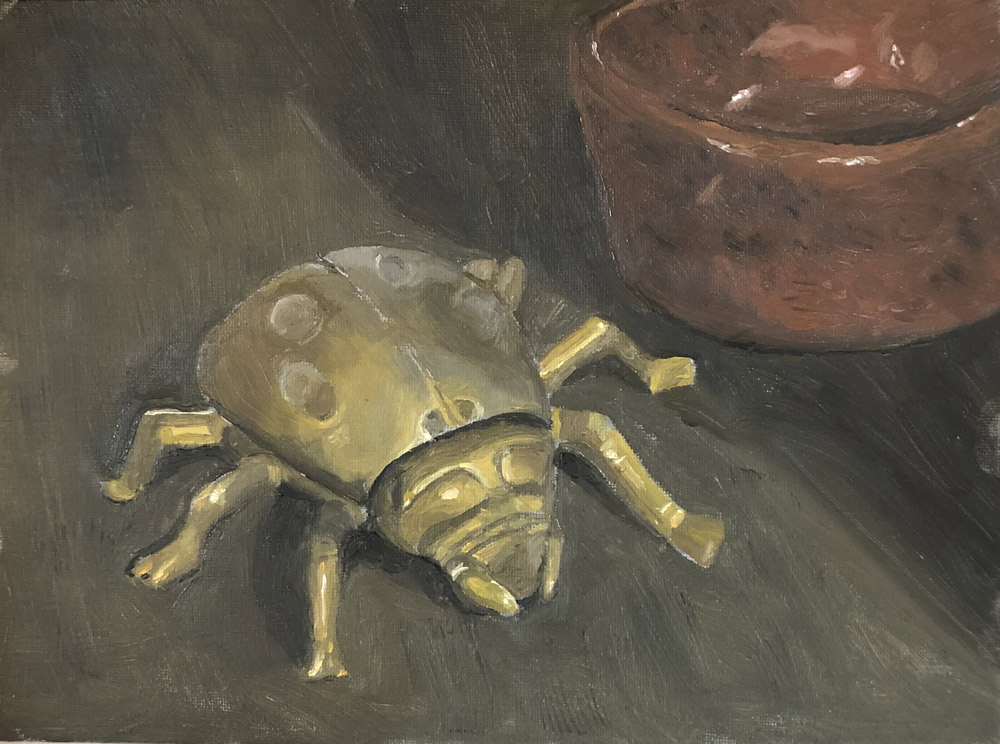
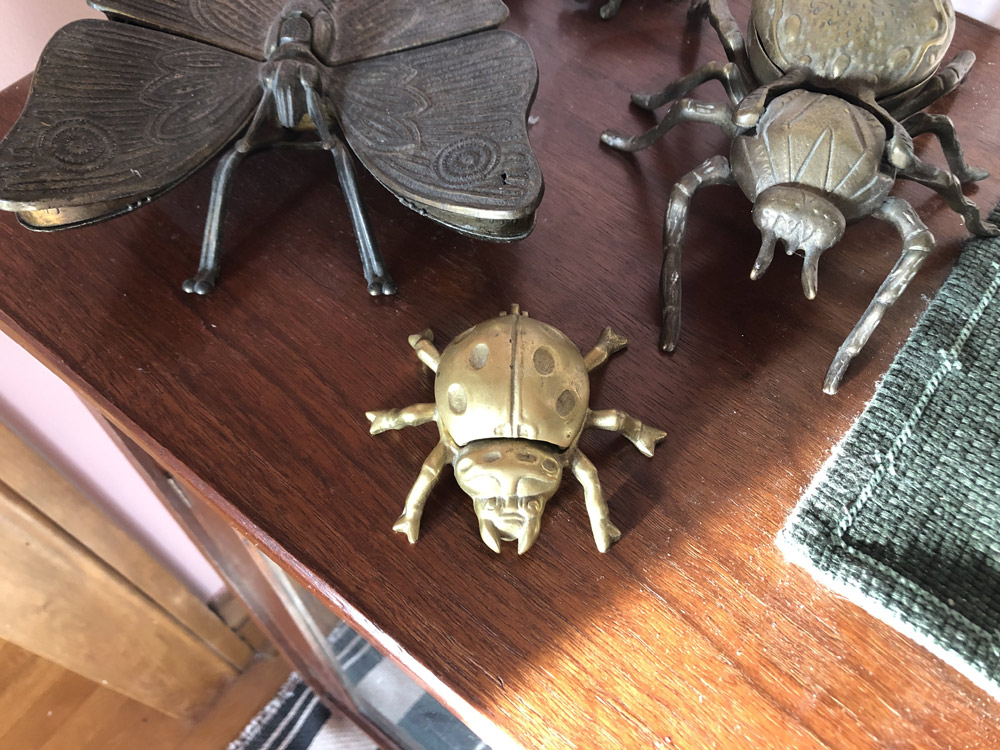
Good Lord but this was tough. There’s a reason, I’m learning, that people start out with less precise objects like apples and pears: Unless your apple is turquoise and shaped like a banana, it’s almost difficult to make an apple look unnatural — there’s so much acceptable variation. Not so with a machine-made, perfectly symmetrical brass ladybug sculpture with legs poking out every which way: You might not have ever seen one before, but you know what it’s supposed to look like. I drew and wiped off three times before I measured my way to a shape that was even remotely reminiscent of my model.

In his natural habitat.

As I’ve noted, I’ve been reading Carole Marine’s fabulous “Daily Painting,” and one thing she mentions is that she mixes almost all of her paint from three colors: Cadmium Red Light, Cadmium Yellow Light, and Ultramarine Blue. This seemed like an easier way to go than trying to get a sense of the dozen or so paints in my new box, and I didn’t have any other instructions to follow. Instead of simply adding black to a color to make it darker, she typically “greys” the colors she wants to recede, adding different combinations of the three basic colors to make them less saturated. So in this case, since my brass was primarily yellowish, I used mostly Cadmium Yellow Light with a speck of the other two colors for the brightest yellow, and then darkened them further with more red and blue as necessary. My darkest tones are really more of a dark olive green. But — I’m a rookie and this is a rookie painting, so why would you listen to me? Go experiment!

My biggest issue, once again, was light. Not only did the light on my model change throughout my session — making it look entirely different — but I had a bright florescent clamp light pointed directly on my canvas the whole time I was painting. To me, the colors I was using looked vibrant and alive, until I took away the light and…

Well, you see. (Or maybe you can’t — it’s over to the right….a little higher….)

I’m finding as I’m painting on my own that I’m breaking every rule we’re being taught at the school. Fat over lean? Bah! Carefully painting patches of color rather than shapes? Well, that one I should do — but I haven’t been. Shapes all the way. It’s been one thing to follow the correct procedure when I’m painting oven mitts and boxes, but a whole lot more difficult when painting something as complicated as this bug turned out to be. Besides, Carole Marine says she paints her backgrounds last, choosing her order based on the saturation of the colors, so perhaps there are other “correct” procedures as well…. So much to learn!

Things I did well:

I think I did a decent job capturing the way light fell on each object
My bug has decent (though not perfect) proportions and looks three- dimensional (though I do see that the line down the center is off and the right front leg is too wide)
Put a bit more thought into the composition so everything isn’t simply centered
My little pinch pot has a decent texture and shape and was painted fairly quickly

Things I could improve

Too dark!
Background was once again an afterthought — basically thrown together from my leftover paint. Should start thinking about using different brushstrokes and hues to make backgrounds more interesting

And she’s off! Rogue painting #2

Now that I knew how to shade, I figured the world was my oyster (and hey, the world was just a ball — and now I could paint that! ). So despite Jim’s admonitions for having gotten ahead of myself with my last rogue painting, I thought I’d dive in and try a still life. After all, I now had all the tools (including this handy-dandy Proportional Divider – how do I love thee!). Also, I’d been reading the highly motivational “Daily Painting,” by Carole Marine, and was inspired to try to fit painting into my life, well, daily.

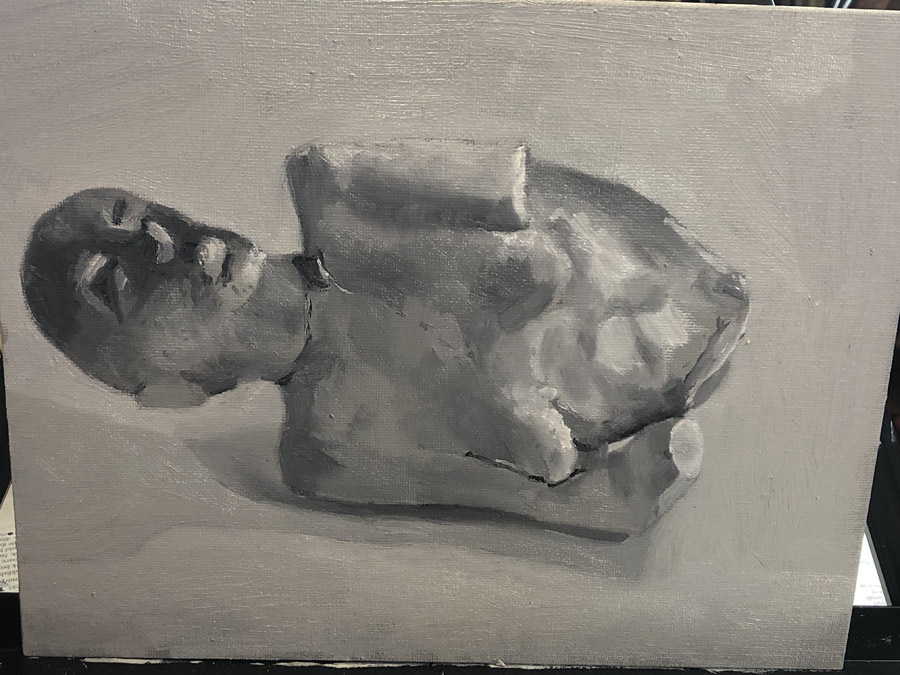
Luckily, it was a Saturday, and Olive had a friend over, which meant she was entertained and I was free to have a marathon paint session. (Carole Marine talks about finishing small still lifes [lives?] within 1-3 hours, but I’m a very slow painter at this point.) As you may be realizing, I have a tendency to want to rush ahead (and that’s a GOOD thing), so I didn’t want to paint no stupid apple. Instead, I chose something a bit more challenging, but with very little color, so I wouldn’t be distracted (and wouldn’t be wanting what I just…couldn’t… have):

bust
Was he the reason my hydrangeas wouldn’t grow?

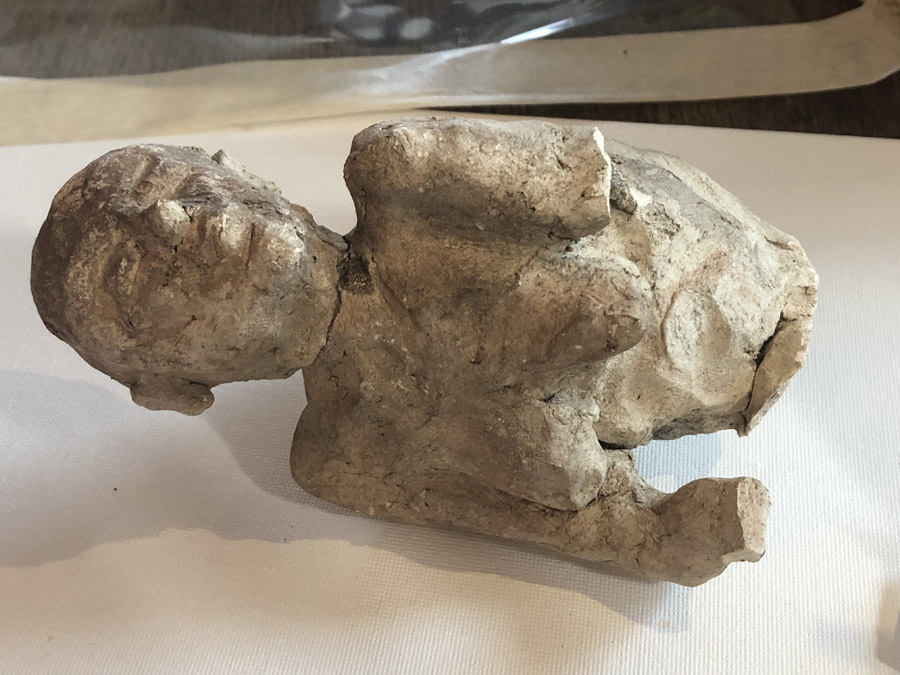
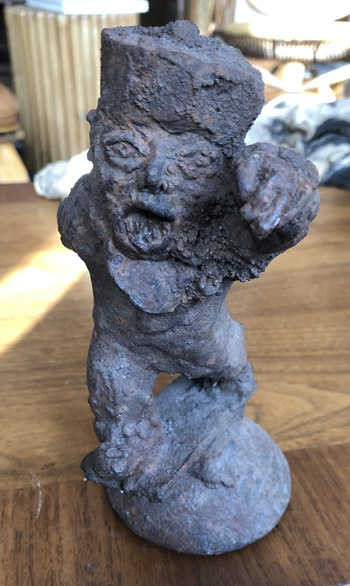
Until a couple of years ago, we lived in a house with a garden, and I was always digging in there and finding the coolest things: a marble foo dog; ancient farming equipment; two super-creepy iron sculptures which have nothing to do with this post but which I just have to show anyway; and the aforementioned slightly less cool…high school art project?…that I decided to use as my model.

Until this point, all of my paintings had been copied from another painting — working with a grid and very systematically plotting each point. I wasn’t even changing the scale or the positioning: The original paintings were the exact size we’d be painting them — we just created our paintings in the same corner of the canvas where they’d appeared on their clipboards, and taped off any overhang. When I’d sat down to paint a still life, I hadn’t thought about how big a leap it would be from our class assignments. After all, I knew how to shade now, and I already knew how to tone my canvas, and how to draw out my subject matter (and how to hold my paintbrush!). How hard could it be?

Turns out, very. Working without the grid, I found myself relying very heavily on my proportional divider. This is a tool that looks like an off-center X — on one side is a small pincer that you hold in front of your object to determine the length of a line or the width of a segment; on the other, a larger version of the same that opens or closes to show how that width would scale up or down, depending on your settings. It allows you to more easily scale up an item and still keep everything proportional, and is a godsend for those of us whose brains don’t work that way. But it’s slow to measure every little thing (as I’m always wont to do) and not always accurate, as a tiny miscalculation of the width on the small side can be a huge shift in width on the large side.

The other thing I found difficult was the lighting in my “studio.” Since I live in a small condo, my “studio” is really just a section of my living room. In attempting to make my painting more “daily,” I’ve carved out a period really — insanely — early in the morning, before anyone else is up and before I need to start work. This means I’m usually painting when it’s dark outside.

I wish I had a dedicated space in which to paint, but I can’t see it happening until, say, my daughter moves off to college (and unfortunately she’s not the next Doogie Houser). I’m loving learning to paint, but I’m not committed enough to, say, install florescent lighting in my beautiful public space.

Instead, I’ve been trying to make do, and my efforts have either been too minimal (where I can’t see my canvas or subject very well, and end up with little halos around everything) or too much (where I have a florescent bulb perched on a bookcase over my shoulder, making everything shadowy). I can’t seem to get it right.

This first still-life shows my struggle. Since it was a Saturday, I was able to start in the afternoon, and the body shows that. But look at that weird dark face! By the time I got to that area, the sun had gone down, I had turned on my florescent, and the entire thing was in shadow, with my florescent spotlight dramatically illuminating the eye sockets and upturned nose. That would be fine it was consistent throughout the entire composition, but it’s completely out of place.

Likewise, I need to train myself to get up and take a break when I start to just. want. to. be. DONE. I’d reached that point before putting in any of the details in the stomach region, and it shows. Instead of the swirls of plaster, I’d basically just thrown in a mix of lighter and darker brush strokes, which looks cloudy rather than solid and scratchy.

Things I did well:

Top arm/shoulder shading and top boob
Crack in plaster around neck (though the larger crack/hole is a bit much)
Shadows under the body
Proportions are reasonably accurate

Things I could improve:

Bottom boob looks like she has a skin disease
Lighting on face
Texture does not look rough enough (especially on stomach)
Composition: Just plopped there, centered and floating in space.