I made a vase! Reinventing my composition in Photoshop


Three weeks ago, my dog died. I’d lost other pets before, but Buddy was my shadow – my “heart” animal – and I wasn’t there to comfort him at the end. I’d written a long post about my grief and anguish, but I didn’t post it, and now I don’t want to.

Instead, let’s talk about painting.

One of the struggles I’ve had – even when I took my first painting classes in my first go-round with this blog – is that I cannot seem to get my lighting right. I recently made strides with the lamp that lights my canvas and palette – investing in a fabulous dual-head “Duo Pro” to reduce the glare I was getting – but my still-life set-up is still pretty grim. I keep hearing that virtually anything will do – just buy a cheap clamp light! – but the shadows that I’m getting are way too…shadowy… and every scene I set up appears as a nighttime scene.

Which it is. Because the university where I work brought us back to the office four days a week (blech), and in Minnesota, that means that most days I’m never in my home during daylight (again, blech). It also meant that this particular still life was set up from what I could find in my studio (aka “the living room”) at 5 a.m. while trying not to wake my family.

In other words, me no likey.
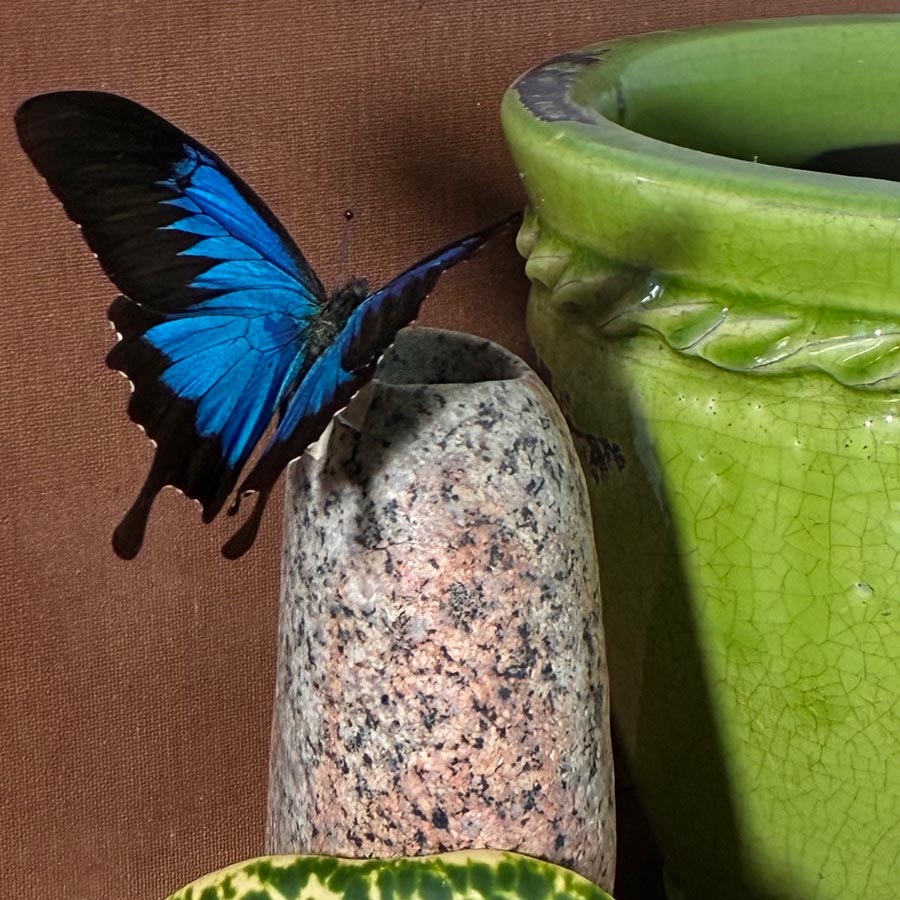
The original set-up

But hey, I’ve got Photoshop! As much as I would love to be someone who consistently paints from life and not photos, it’s just not logistically workable for me – I don’t have room to keep a still life set up, I’ve got a lighting problem, I’m not always going to be able to paint something in a single sitting. So in this case, I thought I’d take my lousy photo of my lousy still life, and see if I could make something less lousy to paint.

One thing I’ve found helpful when choosing a composition is to zoom way, way out on a photo and see if it still makes sense at a tiny size: Does my eye go to the right place? Does it still look harmonious? Can I even tell what I’m looking at? Looking at my photos of this set-up, I realized there were simply too many competing values, and it was the leaf (as the most detailed and high-contrast item) rather than the butterfly (my intended focal point) that caught my eye.

I started by working in Photoshop to crop out the leaf, mute the pot, lighten the butterfly shadow and bump up the saturation of his wing… everything I could do to ensure that the butterfly was the uncontested focal point.
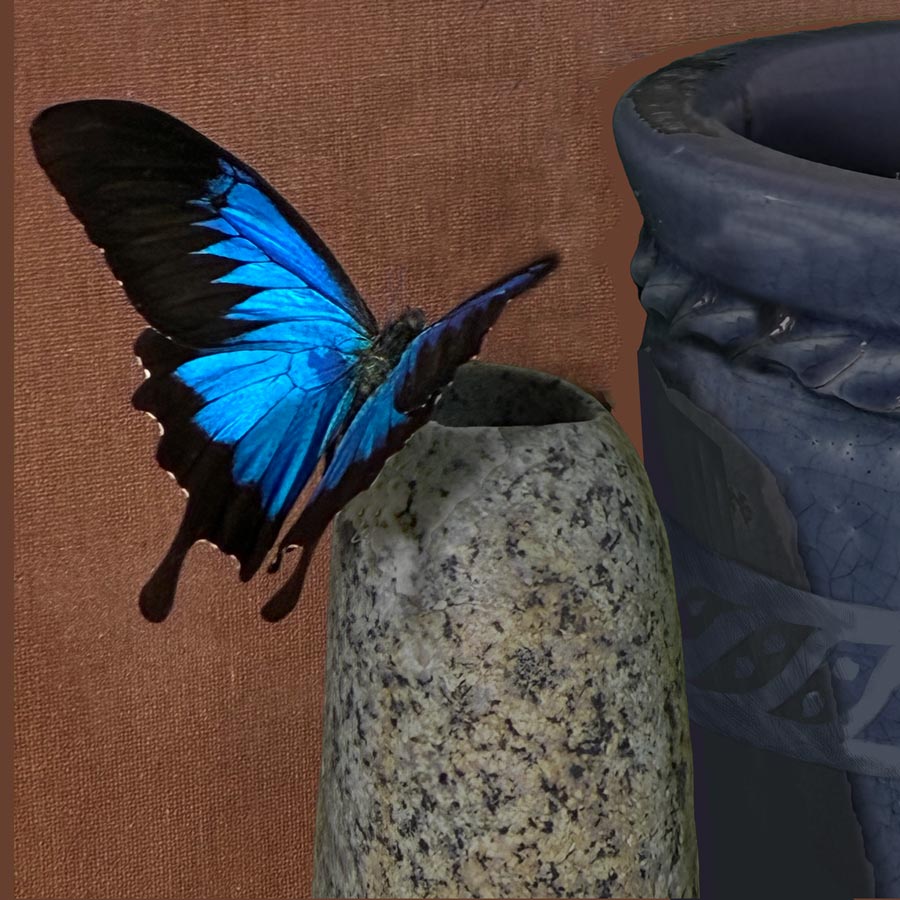
But that didn’t seem like enough — everything was still too mid-value and blah. So I continued to pick, until I’d basically recreated the whole thing in digital paint, completely reinventing the pot in the process:
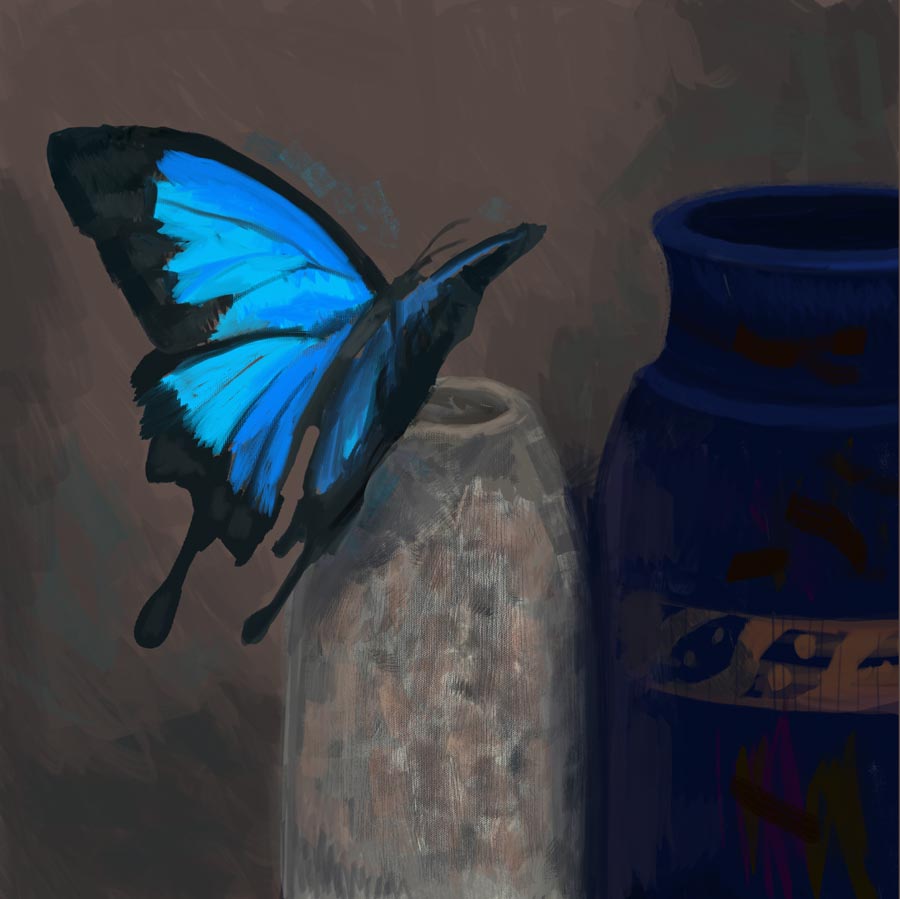
A much cleaner composition!

This is why I’m moving away from digital — as much as I enjoyed “painting” this, it still looks pretty darn digital. But it does give me something to paint that simply wasn’t available to me in real life. (I wish I did own this pot, though — it’s pretty cool!)
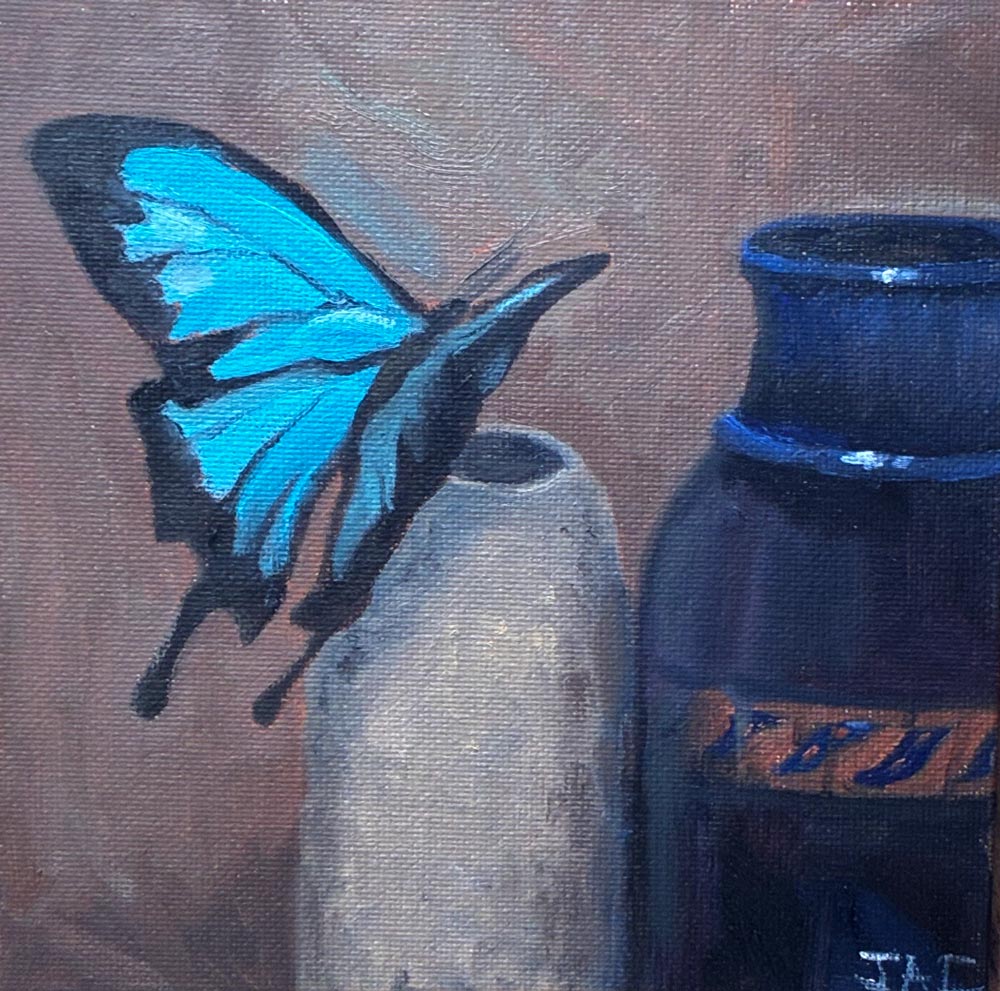
The finished product

This still isn’t great — it’s a bit…lifeless (even disregarding the dead insect that it’s built around). And unfortunately, I didn’t pay enough attention to my eye line, and the perspective is off. But I think I managed to take a sow’s ear and make it… a slightly prettier sow’s ear.

Onward!

Paintings 7 & 8: Getting my ducks in a row

Fresh off the success of my “pigeon with a hat” painting, I thought I’d try something completely different: a duck in a hat! Maybe this will be my niche?

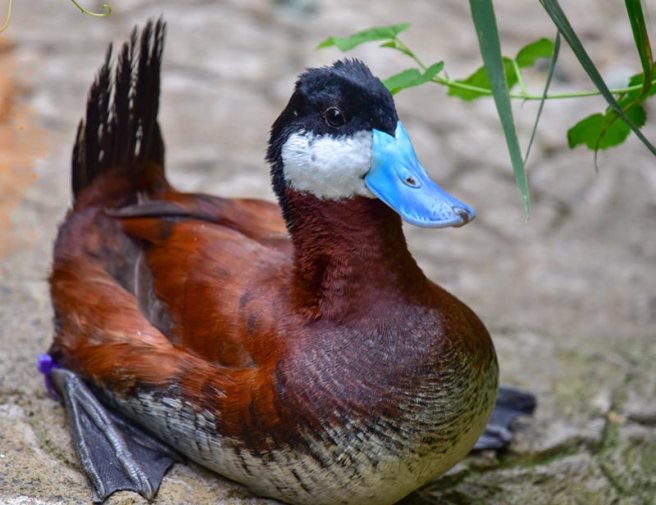
I’d originally anticipated painting a standard “barnyard” duck, but while looking for photos to study I came across this blue-billed marvel called a “ruddy duck.”

Copyright Sinclair Miller, Maryland Zoo in Baltimore

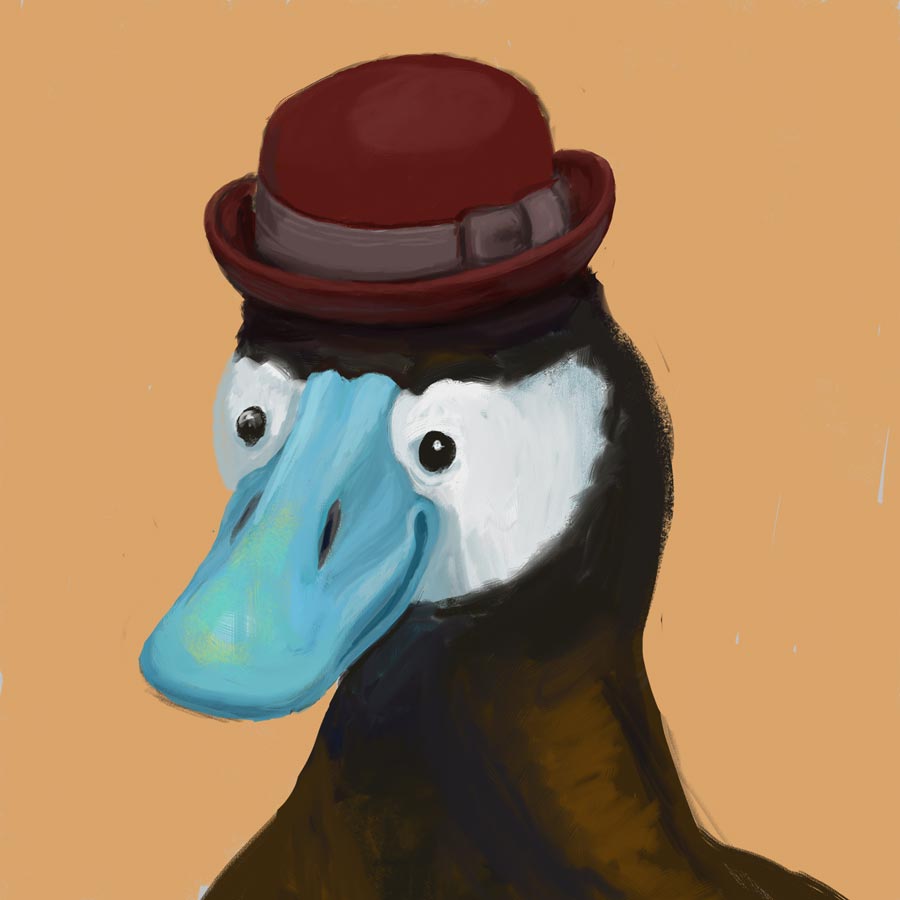
Here’s my original digital:

Good-lookin’ fella!

Apparently, my dapper gentleman is also a randy duck – the blue coloration only comes out when he’s hoping to mate (as does, of course, the stylin’ hat).

Since my pigeon was way off in her background-to-head ratio, I learned from my mistakes and blew up this feller larger in his frame than I’d originally drawn him. Then, rather than grid or freehand draw him like I did last time, I just printed out a black-and-white version of my digital drawing and used my graphite transfer paper to trace the lines of the black-and-white picture. But once again, I was foiled by my cheapness! Not wanting to waste too much printer ink, I used the “draft” setting, which created an image so washed-out and pixelated that I couldn’t follow the value changes, leading to mass confusion and a first painting that was yes, another “wiper.” 

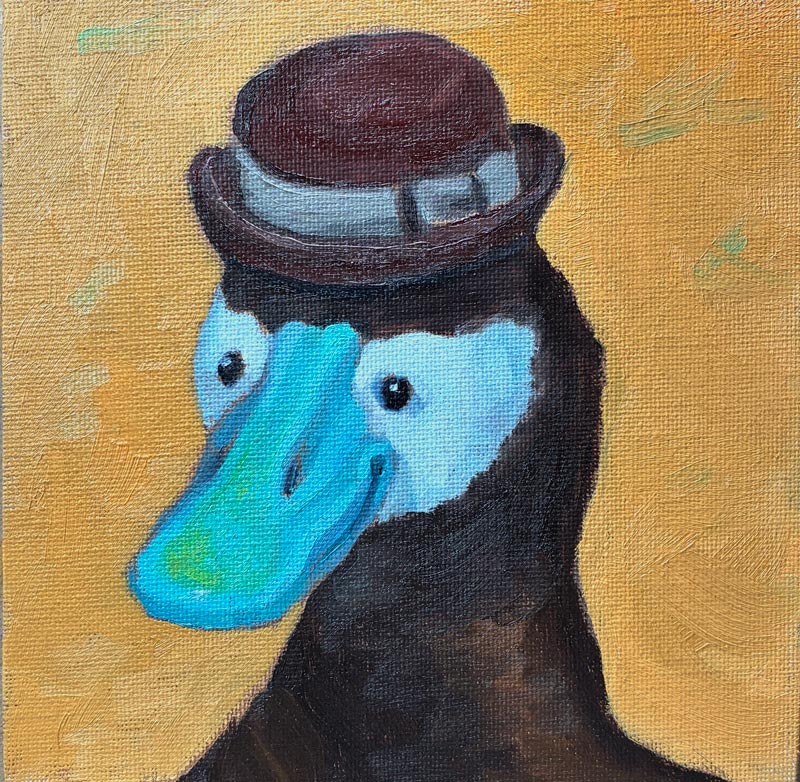
But we Irish-Lithuanians are made of strong stuff, and I set back in to try again. This time, I produced this:

Eek — need to up my photography game!

While it’s not terrible, and the beak turned out better than I’d expected in this second version, I made a giant mess of the hat — that little rim was tough! My background color, too, was not ideal: The orange—while a lovely color unto itself—is too saturated and draws attention away from the bill. Furthermore, Gemini had just told me that I should be painting with a 60/30 ratio of Gamsol to Walnut Alkyd, and my 50/50 mixture was too “fat.” So altogether, it seemed worth it to do one more pass, and begin to develop better processes and habits.

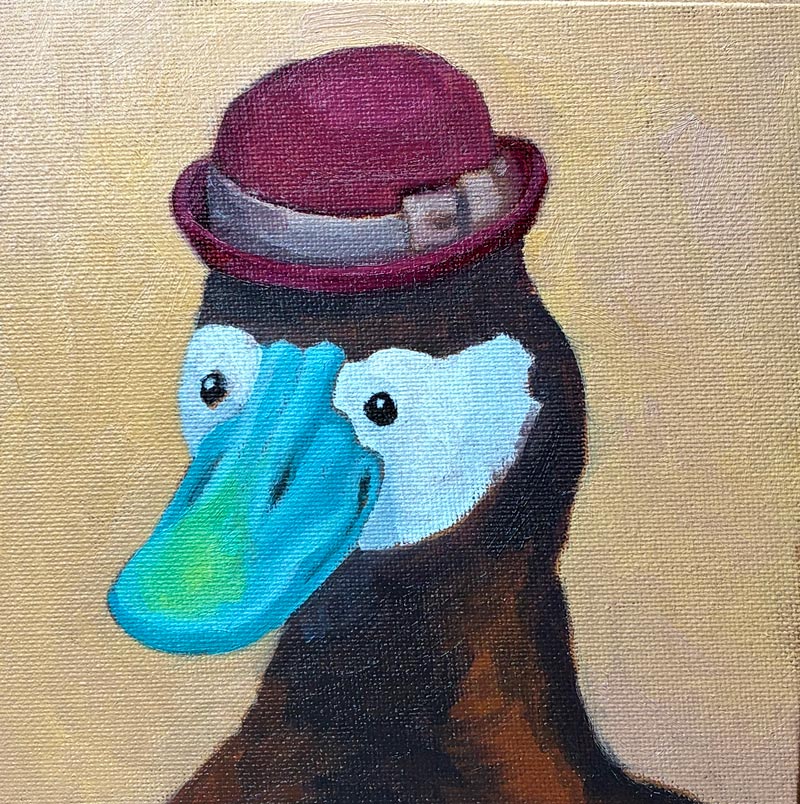
So, I went in for try 3, and produced this guy:

Mistakes, for sure — but altogether a very dapper gentleman!

Painting 4: Revenge of the pomegranates

Why painting 4 you ask? What became of 2 and 3? While I’ve sworn to document even my dismalest of efforts, I’m also not going to finish a painting that’s completely irredeemable (I’m lazy, remember. I’m also cheap — I’d rather save the paint and reuse the canvas). 

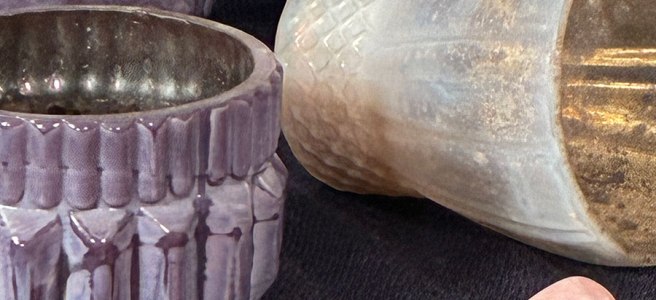
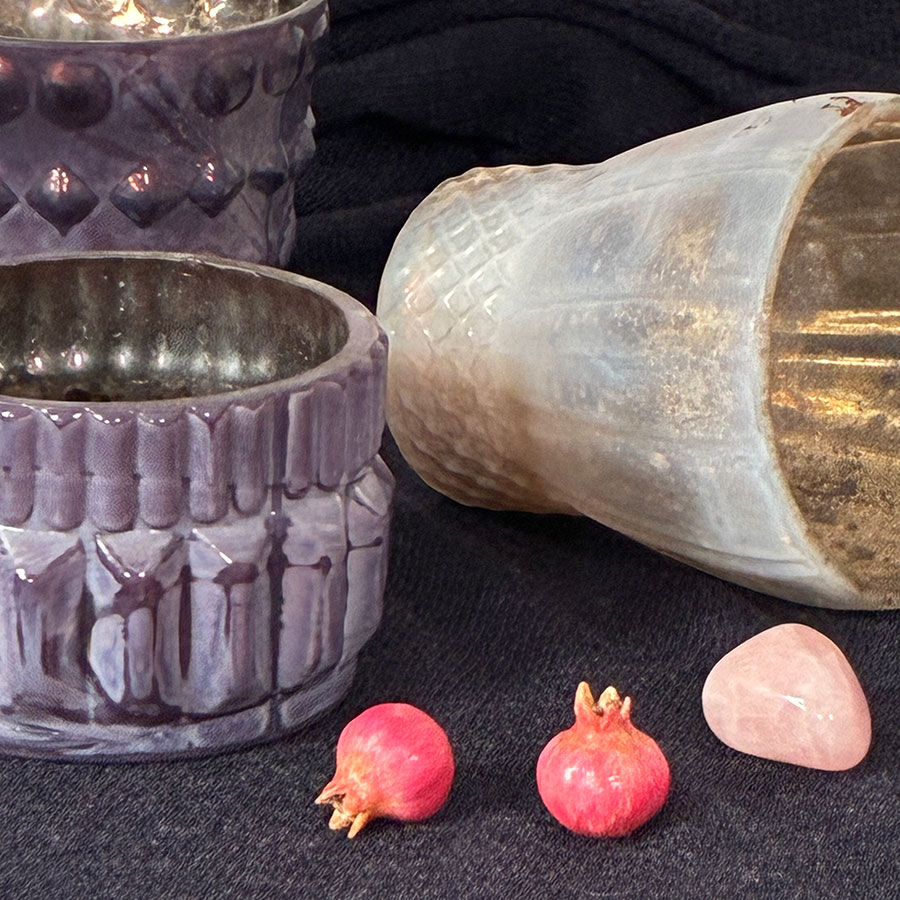
Since my bottle painting was such a raging success, I jumped right into another still life, this one even harder (cause that’s how I roll). Although I was painting from life and not a photo, this was the subject:

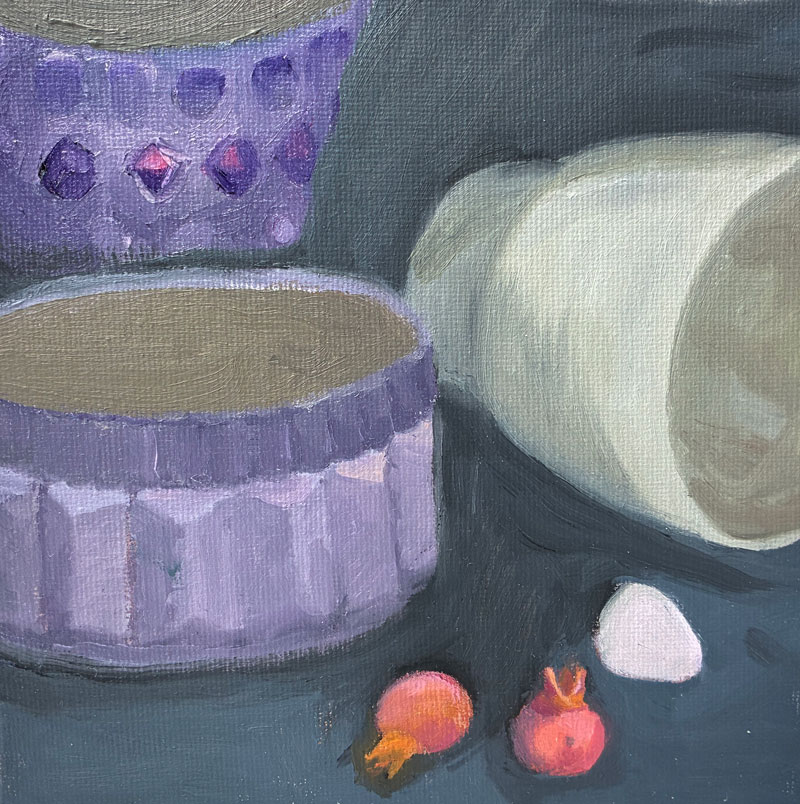
Pretty, right? Also very, very difficult. Now, over the years—since learning to draw from imagination at the tender age of 48—I’ve gotten pretty good at being able to picture something in my mind and draw it from any angle. But I need to really understand the form first, and I could not, for the life of me, understand the form of that purple candleholder at the left front. It has these sort of wedge shaped pieces radiating out like spokes, but the wedges are slightly rounded, and the top of the wedges are more triangular than the bottoms, which follow a gentle curve. Looking at it from a distance in my still life box, the random dark glaze plays all sorts of tricks of the eye so the whole thing just wasn’t making sense any more, and my paint kept getting gloppier and more muddled as I edited and edited.

After two “wipers,” I finished a pass of this one:

Now, I say “a pass,” because even though I’m attempting to finish each painting in one sitting (à la alla prima), I was at a point where I could not add any more paint without it simply converging into the mud. So I thought I’d go back to the traditional method and wait for my paint to dry to the touch before adding more detail, finishing the insides of the cups, and perhaps editing. 

A few days later, however, I was not keen to pick this one back up again, nor was I ready to start over with it before first learning more about what I’m doing wrong. I’ll save this one for the future. 

Next!