Taking it slow

I’m sure everyone has a “worst day at work EVER” story, but I think mine can rival the best of them. I won’t get into the technical details, but due to a perfect storm of miscommunications I ended up DELETING the high-traffic website of a prominent organization. Luckily, there were server backups, and it was only eight hours of information that was permanently lost and not years, but the client was NOT HAPPY and is billing us for time they spent checking everything over; moreover, they’ll have their eyes closely on me for the remainder of the project. Ugh, the shame.

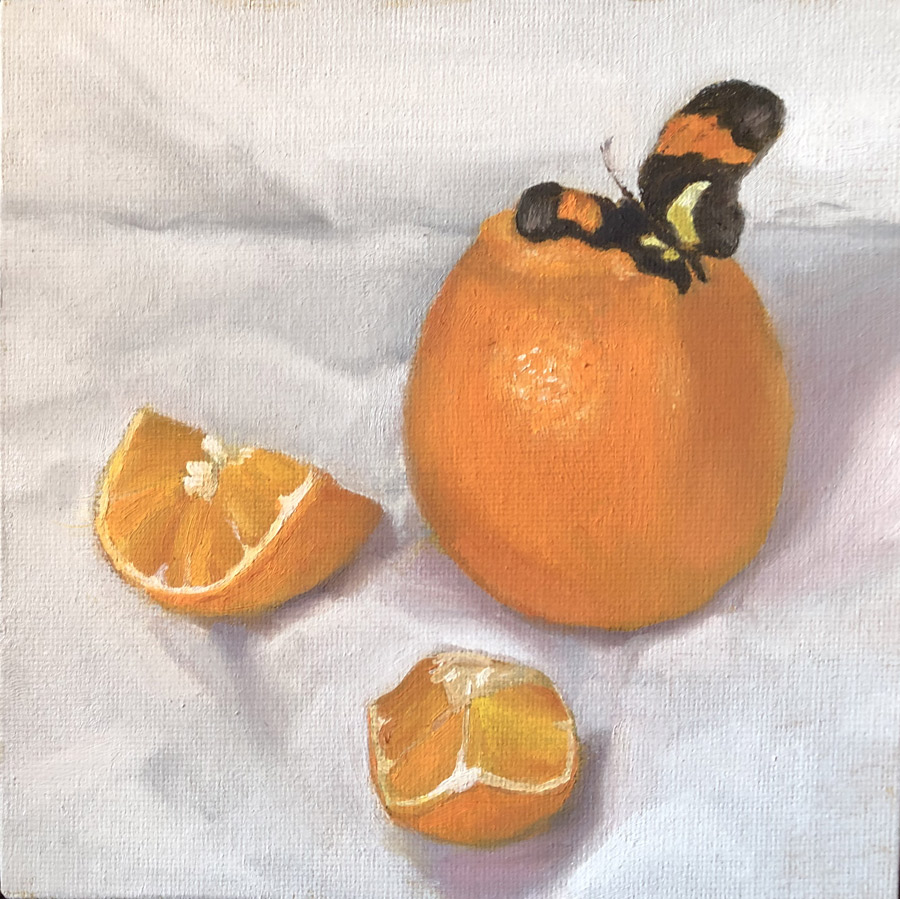
So it’s been a bit of a refuge for me to sit down and think about nothing but whether the shadow on my orange is convincing in this latest still life:

As I talked about a bit in my last post, I’m still trying to find my style… and clearly I’m looking everywhere! While I admire the Old Masters — and LOVE their color palette — I respond most viscerally to work that looks more, well, visceral — loose, raw, and emotional, even if the subject is only sliced oranges.

Unfortunately, when I try to paint alla prima in a loose, bold style, I end up with a sticky mess — it doesn’t look free and raw, it looks unfinished and incompetent. Meanwhile, the more careful work we’ve been completing in class — where we labor over each painting for weeks — ends up looking better to me. Heart-singingly better? No. But slightly less amateur.

So after setting up this still life, I painted only until I began to feel tired — no longer. Then, the next day, I fixed a bit of what I’d done and painted a bit further. And etc., and etc. And although the work looks a bit…labored… I felt loose and free because I wasn’t under the gun to stick with the dang Daily Painting credo. Now I just need to find a way to make my painting more expressive and less “tight” while actually taking it slow.

I’m also still trying to figure out what to do about light. Every morning — if I don’t close myself into my new curtained cave — there’s a moment when the sun first crests over my third-storey sills and for just five minutes or so makes the most perfect pool on my still life. When that happened, my days-old orange slices would suddenly look fresh and juicy, there would be gorgeous swaths of bright fresh sunlight mottling the sheet, and I’d rush to get my camera, only to find that it sucked the life right out of what I was seeing. I’d attempted to produce the same effect artificially — using several carefully positioned daylight bulbs — but everything I’ve tried has fallen far short. I guess I’ll just need to someday learn to paint in hyperdrive (or look over the shoulder of Thomas Kinkade). But for now, I’m taking it slow!

Things I did well:
I like the pinkish shadows that the orange was creating. I also like the two sliced oranges. They look a bit dried out, but in truth they were mummified by the time I finished.

Things I could do better:
The composition is still a bit staid. This is the part I thought would come naturally to me!
It looks as if the butterfly should be creating a harder shadow. I believe that’s a fault of the composition — the butterfly was actually pinned too far above .
The texture on the orange isn’t convincing — it looks like the side of my nose. I’m still not sure how a convincing orange texture is attained!

…And one step back.

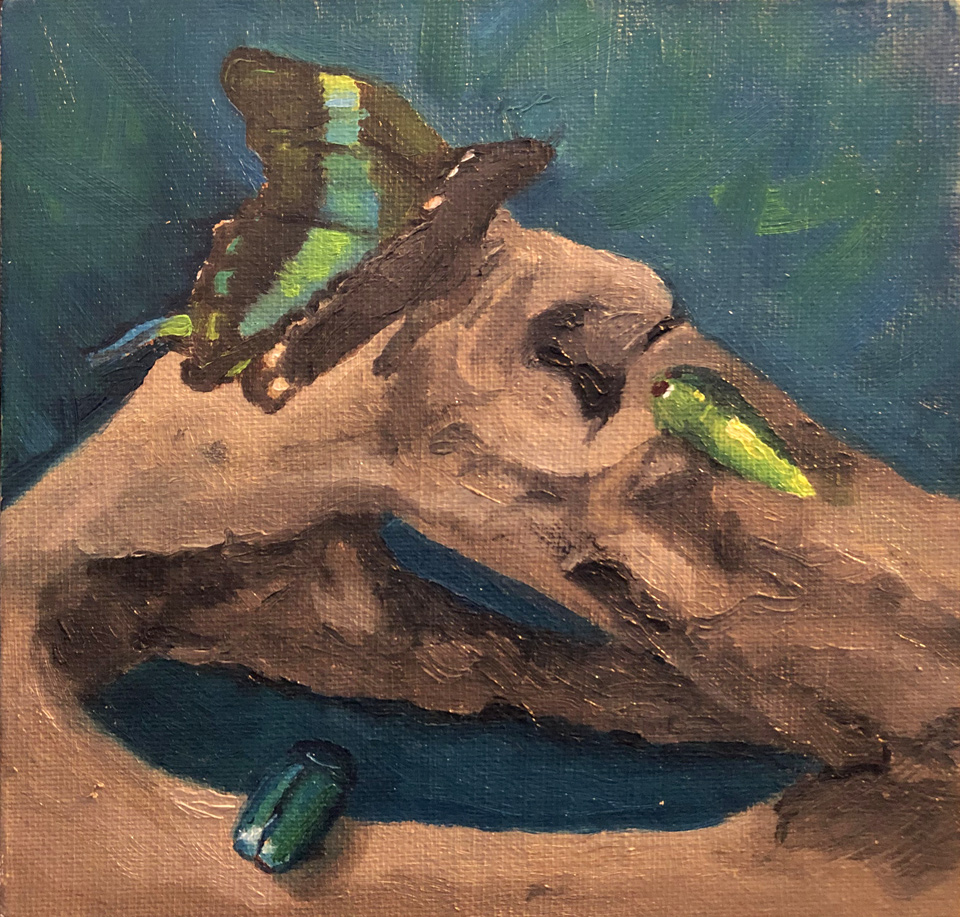
It’s funny how I can mention the same thing week after week — “I did a good job with my values,” “We’re waiting on color so we can work on our values,”– and still manage to miss the mark. I’d been admiring the work on Etsy of this amazing Ukrainian pet portrait artist, and wanted to see if I could create a background like his — loose, unstudied, the perfect complement to the (also perfect) subject. Turns out…I couldn’t.

My original thought was that the green bug would be the focal point and the butterfly and blue beetle would be a similar color to the background and therefore less prominent (I’d read that the area with the most contrast draws the eye the most and should therefore be your focal point). And it is true that parts of the butterfly and blue beetle are fairly subdued next to the dark background — their values are fairly similar. But instead of doing what I should’ve done — simplifying and darkening the background beneath the green beetle so that the contrast is greater, perhaps increasing its size — I plopped a very small beetle on top of a busy area of varying values. Perhaps, if you squint, you still notice it first because of the contrast between the bright yellow and the very dark green beside it, but it’s a close toss-up with the butterfly wing (which has the advantage, of course, of being much larger), and that, in my opinion, makes for a pretty unfocused painting.

While I’m glad that I don’t have even more detail in the background, I’m no Ukrainian Etsy artist. It would’ve been helpful to have a horizon, or some depth of field, and certainly the line of the driftwood should’ve been softened to integrate better with the background. As it is, it looks more like a collage than a painted-from-life still life.

In general, though, the entire thing is just way too complex for such a small (6×6) painting.

What?! Way too complex? Who are you, Jennifer Caritas!

(As an aside, if anyone’s curious about my subject matter, I used to make these fancy insect displays, and still have tons of insect inventory. Look for more bugs in future paintings!)

What I did well:
Individual elements are okay — I actually quite like the blue beetle.
I attempted some brushwork of varying directions and colors — a first for me. A for effort!

What I could’ve done better:
Too much going on!
Too much similarity in values — need a more obvious focal point
Better integration with background

Still life with veggies: I’m a complicated gal!

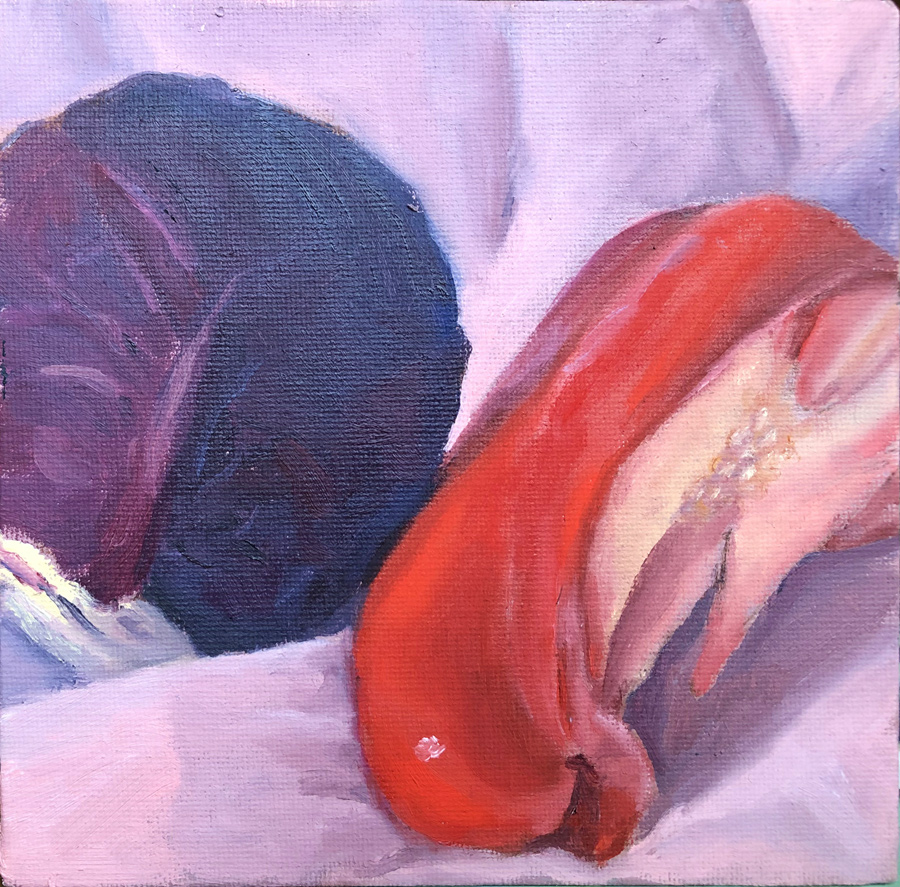
One thing I always tend to do when taking up a new endeavor is to rush in and take on the most complicated challenge I think I might possibly be able to handle, skipping over those baby steps that really build a solid foundation. With painting, it’s not just the challenge though: I worry that if I were to, say, paint apples, my painting would be one of five billion other apple paintings with nothing to really separate it. Logically I know, of course, that focusing on more simple subject matter is a way to develop a style (as a hack — I mean, a novice — I haven’t yet found my style), and that I’ve seen apple paintings that have taken my breath away. This tussle between my logical self and my…self-self (for lack of a better word) is on display in my latest still life: Veggies.

My logical self led the way: I was going to skip the shells and driftwood this time and find something from my fridge to paint. But me being me, I once again got over-complicated (in my defense, though, I’d eaten the other half of my still life the night before).

My proportions seem pretty far off here — the purple cabbage looks more like a purple Brussels sprout (though would a Brussels sprout leave a big purple mark on my husband’s pink shirt?) — and both veggies look a bit cut-and-pasted. Part of that, I think, is because the cabbage is actually half-eaten as well (it’s missing its entire back half), so it’s not casting the shadows one would expect of a spherical object. The pepper, though, also has that effect and I have no excuse for that (I…suck?). I suppose I’m at the stage with this whole painting thing where I can see my flaws but can’t quite identify why they’re happening or how to put a stop to them. It’s a frustrating place to be, but I know, logically, that it’s one step further than not being able to see my flaws at all (I’ve evolved from the Trumpian stage, happily).

Things I did well:
Decent composition — objects aren’t simply plopped in the center any longer — and decent values/contrast
I like the brushwork on the top part of my cabbage — it says a lot with just a few brushstrokes

Things I could do better:
Proportions
Better integration into background

Moving forward? My first still life with controlled light

Once I’d finally gotten my light situation under control, I was ready to see if it actually made a difference in my painting ability. Maybe I actually had a hidden genius inside of me, ready to pop out when the conditions were right!

Jim had sent me a link for building a shadow box, and although that particular one seemed like a bit more effort and money than I wanted to spend, I did find an easy tutorial online that involved simply cutting panels out of the top and side of a cardboard box and covering them with tissue paper. Easy, cheap, works. I’d never quite understood the reason for an actual shadowbox — couldn’t I just put things on the table if I was painting with a tabletop easel? — but I’ve read in several places that it was helpful for controlling ambient light and generating interesting shadows, so I decided to give it a go.

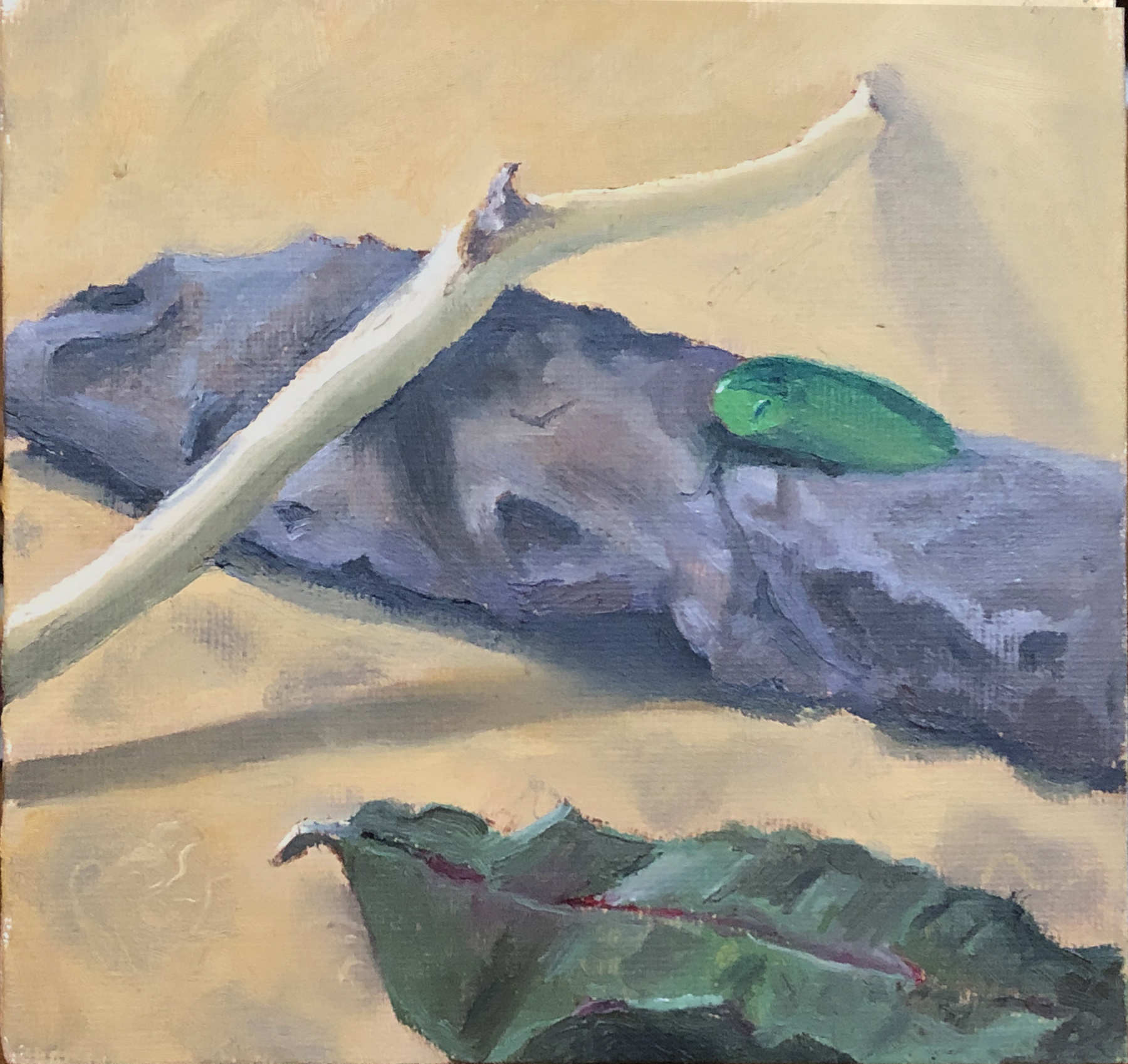
This is, admittedly, an odd composition. It looked much better to me before I put it into the shadowbox — after that, with the shadows that were generated from the harsher light, it started to look a bit…random. The backdrop beneath and behind the objects was a piece of patterned paper — I ignored the pattern when it curved behind because I worried about the amount of noise in such a small painting (it’s 6×6), but it still looks unnatural to have the driftwood stick poking into the back of the box.

Aside from this, though, I actually like this painting. My values look good, and my brushwork doesn’t look fussy like it did in my last painting (stones). I’m not sure I got the light quite right — I was having trouble making sense of this complexity of this crinkled old leaf and winged it — but I’m not sure it’s noticeable to the untrained eye (at least it’s not to my untrained eye). Overall, I think, a step forward!

Things I did well:
Brushstrokes are fairly loose and unfussy
Good contrast and values

Things I could’ve done better:
Weird composition without a meaningful focal point
Intersection of driftwood stick and driftwood chunk is odd — is it floating? Is it resting?
Bug could be brighter — in real life it’s almost metallic-looking (I wasn’t quite sure how to make that happen. Glazing?)