I’m a big fan of expressive painters like Carole Marine and Patti Mollica, and if you’re one of those people who can sit down for an hour or two, pile on the paint with a palette knife, and come away with something like this, you can just go f–
…find a quiet place to paint. This doesn’t apply to you.
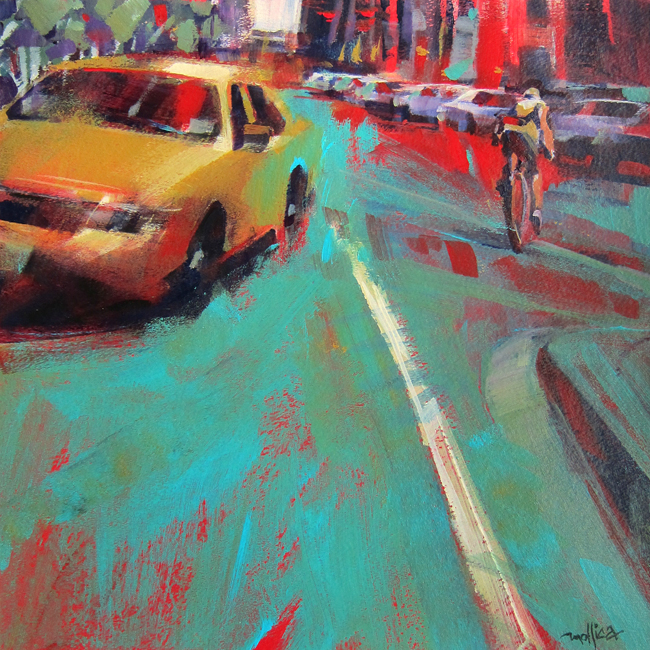
But what if you’re a new painter, and it’s the visceral, immediate brushwork of Patti that makes your heart sing, rather than the smooth perfection of Leonardo? Shouldn’t you load up your brush, pour yourself an Old Fashioned (yum!) and go to town?
Yeah, I tried that:

Ick.
Now, what I did here is apparently a perfectly legitimate way to paint — it’s called alla prima, and it just means I did everything in one swell foop, creating the entire painting while everything was still good and wet. That would be all well and good if I liked it and didn’t want to go back.
But I don’t.
It’s ugly.
The trouble with alla prima for newbies like me is that it revs up the pressure. If you paint a big thick wet layer, it’s necessary to complete it in one sitting (or at least close-together sittings) for the obvious reason that it would be very difficult to revise all those ridges in the next go-round, and the less obvious — but more important — reason that painting a thin layer over a thicker layer will cause the surface to crack, as the top layer dries and the paint below remains wet and mobile at its core.
As a new painter, I’m still at the kids table. Don’t rush me when I’m trying to eat peas with a fork — that shit’s hard!
Instead, I want to be able to lay down a thin layer in the time I have allotted (usually the two hours of class), put the project down until the next class (or whenever), then pick it back up and refine, repeating as often as I like. (And if I don’t finish my layer, no worries!) I could even slap down a big, thick layer of expressive brushwork, alla patti, provided it’s on top. To avoid cracking, the rule you want to follow is “fat over lean”– always start with your leanest, thinnest layers (beginning with your toned canvas), and end with your thickest, most luscious.
But what about the amazing freedom that comes with painting fast, loose, and wet?
Wise woman, that Aunt Lydia.
In an upcoming post, I’ll return to “Dopey and the Oven Mitt,” to demonstrate how we created our layer (in this case, singular). Plus, the big reveal!

 From Mess to Master(y)